
Considering that the rich pays for only 10 percent of the total consumption of electricity, it may be concluded that they would shoulder only 10 percent of the oil consumption for power generation and of residences. And while the rich shares in paying for the oil consumption of industrial and commercial establishments as consumers, it is highly improbable that they, who constitute only around 5 to 10 percent of the population, would consume 84 percent of the products of commercial establishments even as they corner 35.9 percent of the total income.
Ramirez said, “This data alone already refutes Arroyo’s claim of 84 percent share by the rich.”
The breakdown of the projected oil consumption of the transport sector, which constitutes 57.2 percent of the total is as follows:
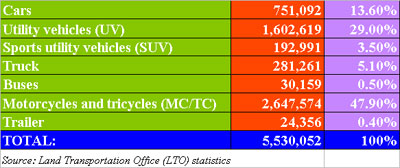
Ramirez said that of the above, the VAT on oil used by trucks, buses, trailers, tricycles is eventually and indirectly paid for by the public, since these are passed on to them as matter of business operating practice.
In 2001, the LTO statistics show that the government owns 4,089 cars and 1,255 sports utility vehicles (SUVs). This means that private car owners comprise less than 16 percent of the transport sector.
Thus, the estimated share of the rich in the VAT on oil is only 9.15 percent. In other words, 90.85 percent of the public directly and indirectly pays for the VAT on oil.
Shortchanged
In a separate statement, the Bagong Alyansang Makabayan (Bayan or New Patriotic Alliance) revealed that the national government may have collected as much as P1.8 billion ($40,700,966) in VAT from Meralco’s lifeline customers alone. The amount, according to Bayan, is P1 billion pesos ($22,611,644) more than the actual subsidy given.
Lifeline users are those consuming 100 kilowatt hour or less per month. The government gave a one-time P500 ($11.30) power subsidy for lifeline customers last month. For 1.7 million Meralco lifeline customers, the government spent P852 million ($19,265,121) for the one-time subsidies, Bayan said.
In her SONA, however, Arroyo said her government allocated P2 billion ($45,223,289) as power subsidy for four million poor Filipinos.
Bayan estimated that for 32 months, 50kWh-consumers paid a total of P470 ($10.627) each in VAT; 70kWh paid a total of P970 ($21.93); and those who consume 100kWh paid a total of P1,830 ($41.379) each in VAT.
Ramirez said, “Only a fraction of the collected VAT is doled out to the poor as subsidies under the signboard “Katas ng VAT para sa mahirap.” (VAT Revenues for the Poor)
In a statement, independent think tank IBON Foundation said that so far, only P9.3 billion ($210,288,298) or just half of the estimated P18.6 billion ($420,576,596) in windfall RVAT revenues is going to subsidies. This leaves another P9.3 billion ($210,288,298) unaccounted for inasmuch as another P2 billion ($45,289,223) in “subsidies” that had been hyped are merely loans that still have to be repaid.
It added that the administration’s “Katas ng VAT” is “a pretense to cover up how the largest part of reformed value-added tax (RVAT) revenues do not go to social programs but rather to paying off debt, militarism and political patronage to prop up Arroyo’s unprecedented unpopular rule.”
The independent think tank also criticized the Arroyo government for making it appear that the share going to social programs is larger than reality. IBON cited the Department of Finance report in 2006 stating that 30 percent or P23.5 billion ($531,373,657) of additional RVAT revenues went to social and infrastructure expenditures. However, the actual amount that went to social services was just P8.4 billion ($189,937,817) or only 11 percent of RVAT revenues.
IBON said further, “In contrast, the administration still insists, in the face of the people’s worsening problems, on allotting some 24 percent of the national budget to interest payments on debt.”
The government is paying P634 billion ($14,335,782,928) in total debt service in 2008 covering interest and principal payments.
Correct math
IBON said that the so-called pro-poor subsidies also do not have any lasting effect for the people who suffer record joblessness, rising prices and worsening poverty.
Ramirez asserted, “Correct math on hard data tells us that the people are better helped by removing the VAT on oil and power, and with the bonus that they have their dignity intact.” (Bulatlat.com)
 Save as PDF






0 Comments