
By Kasheena Camacho
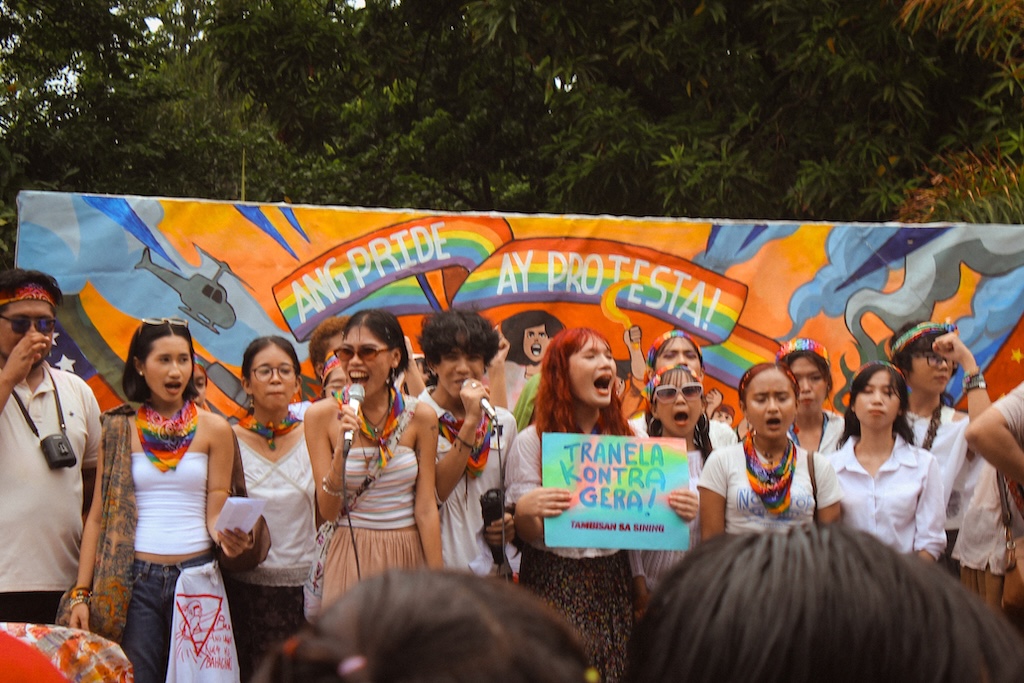
MANILA — It was raining heavy on Friday, June 26 but LGBTQIA+ advocates, allies, students, workers, and other members of people’s organizations gathered at Liwasang Bonifacio to mark Pride Month with calls for the immediate passage of the Sexual Orientation, Gender Identity, Gender Expression, and Sex Characteristics (SOGIESC) Equality Bill, inclusive education, and broader social reforms.
Led by Stonewall Philippines and Bahaghari, the mobilization pushed through despite the alleged failure of the Manila Police District and the Bureau of Permits to grant clearance for the program. Protesters waved rainbow flags and carried placards declaring, “Pride is Protest.”
Beyond LGBTQIA+ rights, participants called for lower prices of basic commodities, a living wage of P1,200 ($19.57), the removal of the 12-percent value-added tax on essential goods, and greater government accountability.
For organizers, Pride continues to be a protest because discrimination against LGBTQIA+ Filipinos remains prevalent, with many arguing that the community’s fight for equality cannot be separated from the struggles of other marginalized sectors.
Jhenine Sioson, chairperson of Philippine Normal University University Student Council Central Student Council (PNU USC), said Pride should continue to be commemorated through collective action, stressing that liberation can only be achieved through sustained mass movements.
“As long as queer people are being oppressed in factories, on farms, and in universities, we will continue to mobilize—even in the rain. The collective resistance of the LGBTQIA+ community and the Filipino people in the struggle for liberation will continue,” Sioson said.
Sioson identified discrimination and the lack of safe spaces as among the most pressing issues confronting LGBTQIA+ Filipinos, particularly in schools, workplaces, and communities.
Adam David, chairperson of Bahaghari UP Diliman, said many of the movement’s long-standing demands remain unmet.
“LGBTQIA+ people are farmers, workers, doctors, nurses, and students. As long as the struggles of workers, farmers, and women continue, the LGBTQIA+ community’s protest will continue as well,” David said.
David also pointed to recent incidents against transgender students as evidence that discrimination in educational institutions remains a pressing concern. He urged the administration of Ferdinand Marcos Jr. to include LGBTQIA+ issues in the upcoming State of the Nation Address (SONA).
The mobilization also featured performances by drag artists, who described drag as a means of expressing solidarity with communities that continue to face discrimination.
For Kennyngina, taking the stage is an act of solidarity with people who continue to face prejudice, discrimination, and human rights violations.
“The reason why I perform here is that I want to show up for all of the people who experience prejudice and discrimination, especially those whose human rights are being denied,” Kennyngina said.
She added that drag has always carried a political message. “Drag has always been political. Any form of art is political,” she said.
Xhin Tax Error, a drag artist and student leader from Polytechnic University of the Philippines, said performing at Pride protests helps open more spaces for queer people in the community.
“We need to open places for queer individuals because, until now, we have been oppressed,” Xhin said. “The moment we put on our wigs, our makeup, and go on stage—even in clubs—is already political.”
Keisha said she joined the protest to support the LGBTQIA+ community and advocate for the rights of transgender women.
“As a trans woman, I am fighting for trans women’s rights. We’re also here to fight for the SOGIESC Equality Bill because it is not just about LGBTQIA+ rights—it is about human rights,” Keisha said.
Although not part of the performance lineup, drag artist Oktubra said Pride protests bring together different sectors whose struggles are interconnected.
“It’s important for us to show up because this isn’t just about the LGBTQIA+ community. People from different sectors are here, and our struggle is also their struggle. That’s why showing up matters. It reminds people that our struggles are interconnected.” (RTS, RVO)
 Save as PDF

0 Comments