
More than nine years have passed since the Philippine government declared the “liberation” of Marawi City after the siege that displaced more than 300,000 families. Some of them are now living in different parts of the country, uncertain if they could return.
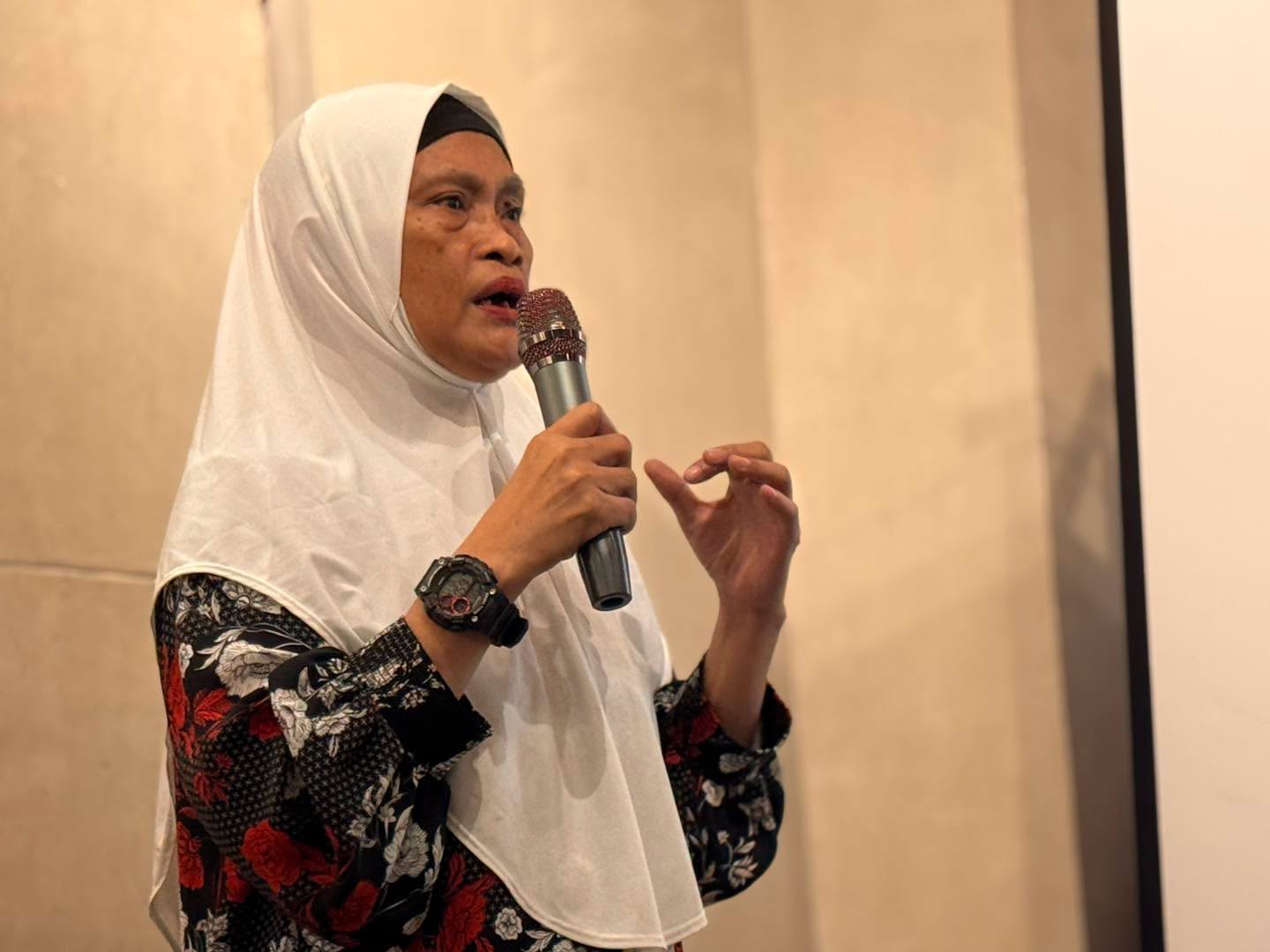
“We were already familiar with the term bakwit (evacuee/displacement). But the Marawi Siege was different. Before, our bakwit would only last for three days. This time, it feels as though we have been permanently driven out of Marawi,” Baiminang Madale, a displaced Maranao survivor living in Manila, said in the vernacular during the opening of Alongan sa Marawi (One Day in Marawi) exhibit.
The exhibit runs until November 15, 2026, at the Rift Gallery Edsa. It is organized by researchers, journalists, survivors, and advocates to commemorate the ninth year of the city’s so-called liberation. It seeks to provide a visual experience of Marawi from the survivors’ perspective.
“The Maranao, like other tribes and communities, have our own culture, dreams, and lives. Because of the Marawi Siege, we feel as though we have not simply been stripped naked, but forcibly stripped out of our homes that shape our identity,” Madale said. “Marawi is the very heart of the Maranao people. Imagine suddenly losing everything—it is far worse than a nightmare. We never thought something like this could happen to us.”
The Philippine government declared October 17 as Marawi Liberation Day starting in 2017 to mark what it called as a “military victory” against the Islamic State-linked Maute group after a five-month battle.
Madale, who is also part of the board of Ako Bakwit, a group working for the welfare and rights of internally displaced peoples (IDPs), said that there are many more families like hers forced to live in Manila since the siege.
Earlier this year, Bulatlat reported that the displaced families have yet to return to their homes in Marawi. Around 17,000 families or 80,000 individuals are still living in 15 temporary shelters in Marawi and Lanao del Sur, according to Marawi Advocacy Accompaniment.
Read: After 9 years, Marawi displaced families have yet to return to their homes
Under the Marawi Siege Victims Compensation Act of 2022, any owner of a residential, cultural, or commercial structure, and other properties in Marawi’s 24 MAA and eight barangays considered as other affected areas (OAA) is entitled to monetary compensation subject to verification.
Compensation claims, under the law, shall be filed within one year from the date of commencement of the filing (July 4, 2023) to the date of its termination (July 3, 2024).
Read: Group opposes Marawi Siege compensation planned changes
Data from the Marawi Compensation Board (MCB), the government body that awards monetary compensation to eligible claimants, showed that 3,699 claims were resolved from 2023 to June 30, 2026, amounting to P6.154 billion. This is 25.51 percent of the estimated 14,497 total claims to be resolved by the body by 2028.
Mindanao State University Prof. Sorhalia Latip-Yusoph said that the recovery and return process for the survivors are hurdled by a tedious bureaucratic process.
“The government’s requirements for returning are extremely difficult to meet. Sometimes, we do not understand why the process has to be so difficult. Perhaps they want to be strict,” Latip-Yusoph said. “Our fellow Maranaos (in bakwit) are truly the ones who, if we may put it this way, are the reason our hearts continue to ache. Many of them are still living elsewhere. I hope we will not reach the tenth year without being able to return home.”
Task Force Bangon Marawi was a government inter-agency task force group established by former President Rodrigo Duterte in June 2017 to facilitate rehabilitation, recovery, and reconstruction.
However, Madale said that the four stages of the task force’s process did not align with the needs of the IDPs and survivors of the Marawi siege. The process includes registration, mapping, submission of documents, and biometrics. However, most IDPs lack valid identification and their house/land ownership documents– most of the time– are not recognized by the government implementers.
“The process is inhumane. Even application to the Marawi Compensation Board (MCB) is difficult. They even prioritize illegal claimants,” Madale said. “I hope our government finds a dignified way to help us.”
She said that for many displaced survivors living in different parts of the country, going back to Marawi to process compensation means financial resources for the transportation, logistics, and even temporary shelters. MCB does not provide comprehensive compensation and is only limited to lands and titles.
Moro indigenous leader Amirah Lidasan condemned the celebration of the Armed Forces of the Philippines (AFP) of the so-called Marawi liberation annually, stressing that there is nothing to celebrate in the widespread human rights violations that transpired during and years after the siege, especially with the bombardment of the city.
“What kind of liberation is this when justice remains denied to the victims and their families, with more than a hundred killed and still missing? Thousands remain barred from returning to their communities, while the government prioritizes tourism infrastructure and a military camp over the people’s right to return,” Lidasan told Bulatlat. “Compensation remains inaccessible to many due to inadequate and uncertain funding. And those responsible such as the AFP were not held accountable for the violations.”
Moro Consensus Group said that such a celebration is not a day of triumph but a “stark annual reminder of unresolved justice, state neglect, and unfulfilled promises.”
The group called on the national government and civil society to establish an independent Truth Commission to investigate the security and political lapses that led to the 2017 siege. They also denounced the pace of processing and payout of the compensation for the survivors.
“Despite thousands of legitimate applications filed by victims who lost their homes and loved ones, the current pace of processing and payout remains agonizingly slow. Thousands of affected families have yet to receive a single peso of their awarded compensation,” Drieza Lininding, chairperson of Moro Consensus Group was quoted in a statement.
What is more appalling for survivors is that there has been no accountability for the siege and the disproportionate military response.
“The military response to flush out the militants relied on months of relentless aerial bombardments and heavy artillery. This indiscriminate approach resulted in the complete devastation of the Most Affected Area (MAA), turning cultural heritage, ancestral homes, and thriving commercial hubs into pulverized rubble,” Lininding said.
Survivors lamented the mainstream portrayal of Marawi as a hotbed of violence and terrorism, dubbing it as a false narrative. Independent journalist Raizza Bello said that the exhibit provides an avenue for the survivors and advocates to see the beauty of the community in Marawi.
“The portrayal of Mindanao is always associated with violence and terrorism, but I witnessed firsthand that Mindanao is not like that. The people there were peaceful and welcoming. Our invitation to the exhibit is to, at least see or take a peak, or experience a day in Marawi in the lens of the displaced or bakwits,” Bello said.
Latip-Yusoph stressed that the city, prior to the siege, was considered as one of the peaceful cities in the Philippines. “We are peace-loving citizens. We love our community, and we welcome our visitors. Yet they portrayed Marawi as a place where you would be in danger if you came here. That was deeply unfair.”
Read: Resolve the continuing Marawi displacement, Marcos Jr. urged
The Philippine government is left with less than two years to process the compensation for survivors before the MCB ceases to exist, since it has a statutory sunset clause that expires in 2028.
There are also more than 3,000 compensation claims that have been transferred to the National Housing Authority (NHA), especially for the properties demolished due to the public infrastructure development under the government’s Marawi Recovery, Rehabilitation, and Reconstruction Program.
“I do not want to think that we have been defeated. The fact that we have this exhibition and gathering means that we have not been defeated. There are still people who care,” Latip-Yusoph said. “In Maranao culture, we have a saying: a single strand of hair may only be strong enough to cut one egg. But when many strands come together, they can stop a large boat.” (RTS, DAA)
 Save as PDF



0 Comments