
In their first CBA draft, the union demanded for a P20 (P0.42 at the 2009 exchange rate of $1=P47.637) increase in their daily wage. The average wage of a BMMC worker was pegged at P407 ($8.54), the minimum wage set for the National Capital Region. They also wanted the implementation of the previous method for computing their 13th month pay, which was arbitrarily cut in half by the company.
It was only in September 2009 that the management first sat on the negotiating table for the CBA. The next negotiations were derailed again, as the management reasoned out that the typhoon Ondoy affected the company’s production.
The workers deemed that the management was deliberately delaying the CBA negotiations. “They refused to talk to us,” Bongon said.
Collective Action
By February 2010, when the management still did not negotiate with the workers, the workers began holding a five-minute noise barrage as a sign of protest. The noise barrage would later on last for 20 minutes.
By March, the management finally sat with the workers for the CBA negotiations. Juanito Lim, the company’s lawyer, proposed for a two-year moratorium on CBA which the workers rejected. Negotiations reached a deadlock.

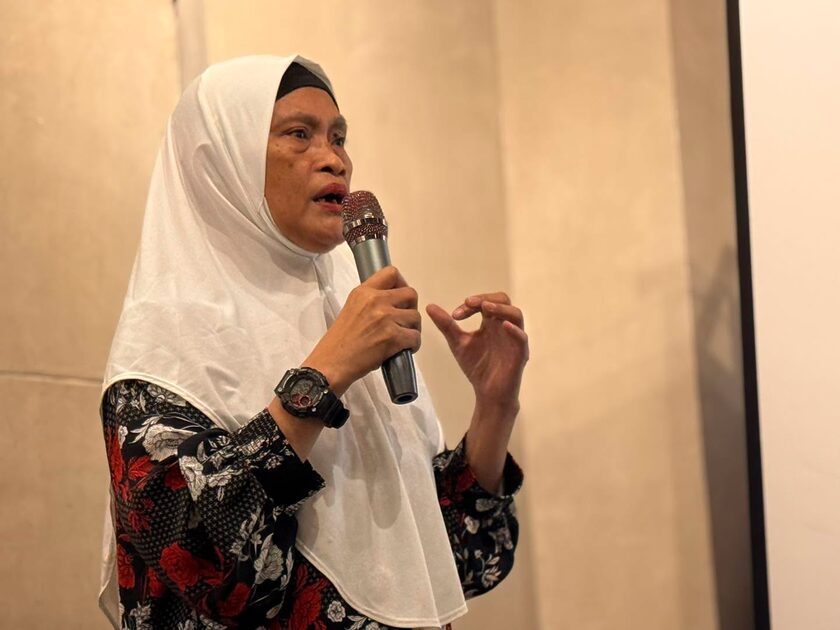
Bleustar Workers Labor Union president Gloria Bongon. (Photo by Ronalyn V. Olea / bulatlat.com)
To exert pressure on the management, the workers trooped to the company office on a daily basis. They also did a work slow down. From a 30-minute halt in operations, the workers stopped the production for four hours.
The union filed a notice of strike (NOS) in September 2010. Less than a week after the filing, the management, now represented by another lawyer, faced the workers. Negotiations ensued. Both parties agreed to a P5 ($0.11 at the 2010 exchange rate of $1=P45.10) daily wage increase. The management earlier proposed a P3 ($0.07) hike. The management also acceded to the union’s demand regarding their 13th month pay and the recognition of the BWLU.
Despite agreements reached during the negotiations, the management did not sign the CBA right away. The union charged the company with Unfair Labor Practice. The union again staged a strike. After four days, the management finally signed the CBA.
After the signing, the union immediately went to the DOLE to register the concluded CBA. DOLE officials however, said they could not issue a certificate recognizing the CBA because there was a pending Petition for Certificate Election (PCE) filed by another union in the company, the Advan United Workers Labor Union (AWLU). ALWU is a union affiliated with the Trade Union Congress of the Philippines (TUCP). The petition stated that there was no union in the company and no CBA negotiation existed between the workers and the management. AWLU filed the PCE in September 2010, before the management began to negotiate with the BWLU for the CBA.
“The management wanted to implement a no union policy. It connived with the TUCP against us,” Bongon said, adding that the management itself persuaded the workers to join the AWLU.
In January this year, the DOLE released the decision in favor of the AWLU. The BWLU appealed the decision and asserted the recognition of the concluded CBA. The DOLE refused, and went on to schedule the election date on Feb. 18.
The BWLU won the certification election and finally registered the concluded CBA. Bongon said that the management again demanded for a CEBA as a precondition for the collection of union dues. On March 8, the union finally obtained the CEBA.
“We won because of our collective action,” Bongon said. “For every form of oppression the management employed on us, all the more we became determined in pushing for a genuine union. We, the women workers, are undeniably instrumental in achieving victory in our struggle.” 
 Save as PDF
0 Comments
Trackbacks/Pingbacks