
Oplan Bantay Laya (Operation Guard Freedom)
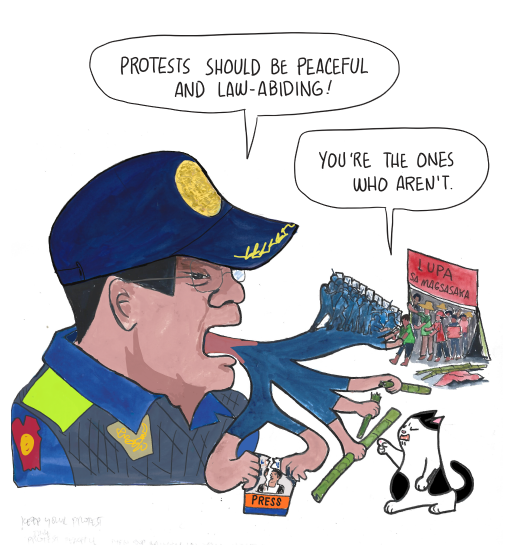
It appeared that many summit participants were prepared with their inputs for the agenda towards a “holistic” solution to the killings, whether in terms of strengthening the judicial power or in making sure that the victims’ constitutional rights are protected. However, this was not going to be easy. Those representing the Macapagal-Arroyo administration’s security agencies used the occasion as yet another battlefield of their Oplan Bantay Laya (Operation Guard Freedom): to “win the hearts and minds” of the summit, with a bag of counter-punches against the Left, particularly the human rights alliance Karapatan (Alliance for the Advancement of People’s Rights). Their slide presentations during the plenary and pronouncements in many workshops on the second day showed their avowed role in defending the state against its enemies, reminding participants that the killings should be seen in the context of an internal conflict. One begins to comprehend why government’s counter-insurgency is a wrong strategy because it is premised on the erroneous definition of the problem: The main problem, it was said repeatedly, is simply insurgency.
The men in uniform appeared to have missed what various presidents had admitted: They cannot defeat the armed Left with guns alone. Unless fundamental problems of poverty and injustice are solved, the armed struggle will continue. Jose Almonte, a former guerilla hunter and national security adviser of former President Fidel Ramos, admonished his fellow officers in the summit that to defeat insurgency they must engage the rebels with better ideas and not with bullets. He should have also asked them to re-read the works of Carl von Clausewitz: War is first and foremost a political war.
In the end, the more rational minds prevailed. Among many other proposals, the summit participants sought to expand the Commission on Human Rights’ (CHR) prosecution powers; adopt international laws on command responsibility and determine how the state can be held liable for damages; empower investigators to search government/private premises for victims of enforced disappearances; make killings of activists, journalists, lawyers and judges a special crime; the review of the state’s military approach to the armed struggle and the resumption of peace talks between the government and the National Democratic Front of the Philippines (NDFP).
Many of the proposals seemed congruent with some of the measures that Puno and the SC had in mind in line with infusing judicial intervention in an issue that cannot be addressed by the judiciary’s co-equal branches, by reason of complicity or default. Yet, the soundness of the proposals should be measured not just in their validity but in the fruits they are expected to bear.
Reform is acceptable where there is least resistance. Through the years, the demands of the poor and victims of human rights violations have either fallen on deaf ears or have been muted with reprisals by the state’s reactionary institutions. Congress ended up compromising constitutionally-enshrined rights and liberties, the latest being the Human Security Act of 2007. One can expect that Office of the President will preempt any move that would place it under the doctrine of command responsibility.
Institutional collision course
Given these circumstances, can Puno still uphold judicial activism, mindful that this will put the SC on an institutional collision course with the President and the oligarchs in Congress? Can he rally the entire criminal justice system, along with its prosecutors and magistrates, to help bring coherence to this crusade? Can he put real substance and momentum to his “holistic” strategy against the violence of the state – of which the judiciary is part?
On a positive note, the first step taken by the judiciary towards the search for justice and redress has been done. However, one must not harbor any illusion that the work can bear meaningful results in this generation. More arduous steps need to be taken.(Bulatlat.com)
 Save as PDF
0 Comments