
The Minority Report
The section in Fraud devoted to the report made by the Minority members of the Joint Committee of Congress is titled “The True Report.” In it, the members of the Minority Bloc led by Minority Leader Francis Escudero and Deputy Minority Leader Alan Peter Cayetano gave an accounting of process of canvassing of votes cast for presidential and vice presidential candidates in the May 2004 polls.
Needless to say, it’s a long tale of woe and denunciation. The very title of one of the sub-reports already explains the gist of the entire report: “The Illegal and Unconstitutional Canvass of Certificates of Canvass Which Were Not Authentic and Duly Executed and Refusal by the Majority Members to Open and Tabulate the Election Returns.”
The Minority concludes that the House canvass of votes, as led and facilitated by the Majority, was conducted in six ways, in an 1) unfair and impartial manner; 2) illegal manner; 3) robotic and mechanical manner; 4) unintelligent manner; 5) inaccurate manner; 6) arbitrary manner.
The Minority went through the election returns, statement of votes and certificates of canvasses not only from all over the country, but also from abroad where there was absentee voting for overseas Filipino workers (OFWs) in Myanmar, Qatar, Kuwait, Hong Kong and Ireland. Their conclusion? Massive vote-rigging and countless similar anomalies.
The report of the Minority on the national canvass blisters accusations: the tone is an amalgam of frustration, righteous indignation and lawyerly outrage at how the law has been violated and twisted. It is evident that the writer of this report had to stay his or her hand to prevent himself or herself from using “unparliamentary language”; the occasional insult and threat – “The Majority Members are extremely afraid and apprehensive the truth will come; or “Such unreasonable and illegal acts of the Majority Members will face imminent rejection in the parliament of the streets” – however, slips in, and one actually begins to sympathize with the members of the Minority who witnessed the canvassing and how the supposedly democratic exercise of elections was compromised.
Watchful Mainstream Media
Even before the May 2004 elections took place, the media had been active not only in reporting the usual, expected news that came with elections, but in exploring stories with controversial angles, giving consideration to the country’s history in elections, and the track records of the candidates, particularly those who ran for the presidency.
It is most fortunate that for all the attacks against freedom of the press in the Philippines, the more progressive section of the media did not renege in the duty to expose the truth surrounding the 2004 polls and indirectly assist those who also shared the same mission. Fraud’s credibility is further strengthened by the consistent attribution of reports that came out in the media throughout the elections, the final canvassing, the congressional investigations into the “Hello, Garci” scandal and the deliberations of the CCTA.
The media followed the developments in the electoral fraud investigations and the inevitable surfacing of various witnesses who risked life and reputation to expose what they knew. Through the chaos of swiftly-changing reports and contradicting accusations, a pattern emerged: Macapagal-Arroyo and her camp initiated a plot to win the elections with massive cheating (dubbed Oplan Mercury, as stated in the book) and it was quickly unraveling at the seams.
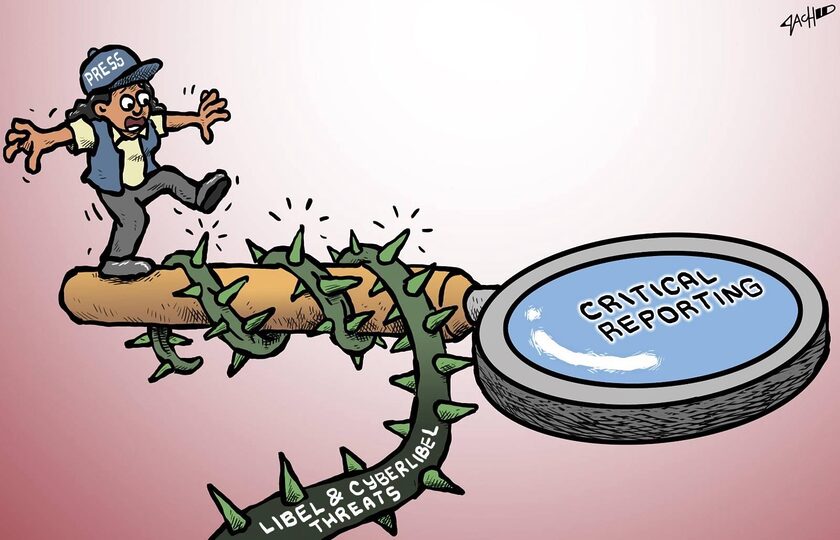
Much thought went into analyzing the allegations of illegal voting even in the mainstream press, meaning it was not only the alternative media that stayed glued to the developments and weeded through the host of various lies and denials issued by Malacañang. The effectiveness of the mainstream press in exposing corruption was proven recently when First Gentleman Mike Arroyo, angry and piqued, filed libel suites against more than 40 journalists for their reports on his being the “chief cheating operator” in the 2004 polls, involvement in jueteng and smuggling, among many others.
Progressive Party-list Groups
Lawyer Cleto Villacorta has two articles in the book, “The Commission of Fraud: Patronage Politics in the Comelec” and “Has the Party List Law Broadened Popular Participation in Governance?” The former gives an analytical look at the Comelec and why precisely it can never have full credibility as an arbiter of clean and honest elections. The latter, on the other hand, is an assessment of the party-list system.
Villacorta tips his hat to the victory of the progressive party-lists Bayan Muna (People First), Anakpawis (Toiling Masses) and Gabriela Women’s Party (GWP), and even to the three other party-list groups which were casualties of electoral fraud: Migrante Sectoral Party, Suara Bangsa Moro (Voice of the Moro People) and Anak ng Bayan (Nation’s Youth).
He lays down the legal framework which these progressive party-lists entered, and acknowledges that they followed the rules to the letter. If laws were followed, the government should even encourage the establishment and participation in the electoral process of grassroots groups, but as Villacorta admonishes: “The Comelec worked lackadaisically on the technical aspects of the party-list elections…The government has initiated and managed a strong-arm campaign against Bayan Muna et al – a State action that is seriously illegal in character.”
Villacorta does not foresee a good future for progressive party-list groups, and understandably so, seeing how over 700 civilians, political activists, human rights advocates allied or directly affiliated with Bayan Muna, Anakpawis and other progressive partylist groups have been systematically killed since Macapagal-Arroyo came to power. Five of the six lawmakers of these partylist groups – Satur Ocampo, Rafael Mariano, Liza Maza, Joel Virador and Teddy Casiño were forced to take refuge in the House of Representatives for three months following foiled attempts to arrest them on rebellion charges. The sixth, Anakpawis Rep. Crsipin Beltran, remains incarcerated nine months since February 2006 on charges of inciting to sedition and rebellion.
“Yes, party-list groups won hands down in the party-list elections,” Villacorta writes. “But at what price, that is, whose lives have to be lost for such victory? There is neither rhyme nor reason for the State to invite varied ideologies and then allow its armed authorities and paramilitary units on a rampage against the progressive party-list groups.”
Villacorta says that a genuine party-list system in this country is doomed to fail and that all elections in the Philippines are doomed to be corrupt and fraudulent given the entrenched orientation of those who run the elections, those who run in the elections, and those who inevitably win the elections using not only guns, goons and gold, but by blatantly twisting and violating electoral and other laws.
Importance of People’s Movement
Finally, Fraud pays tribute to the efforts of the progressive sectors of Philippine society. The Center for People Empowerment in Governance (CenPEG), by coming out with such a book, added to the most growing list of publications and materials that attest to the long-standing campaign of the progressive mass movement not only to expose and oppose corruption in government and all other attacks against the welfare and well-being of the Filipino people, but also to present alternatives to the status quo.
The book takes note of the leadership of militant people’s organizations in highlighting the issues and concerns of the basic sectors they represent. People’s organizations such as the Kilusang Magbubukid ng Pilipinas (KMP or Philippine Peasant Movement), Migrante International, Kalipunan ng Damayang Mahihirap (Kadamay or Association of Urban Poor Organizations) and their leaders coordinated closely with the CCTA in gathering evidence to bolster the various charges of corruption, abuse of office, and human rights violations against Macapagal-Arroyo. The human rights organization Karapatan, in the meantime, provided the conclusive documents and testimonies revealing the viciousness of the Arroyo administration’s military offensives against progressives and sympathizers.
The congressional investigations on the “Hello, Garci” scandal, the deliberations of the CCTA and the continuing debates in the House of Representatives on the legitimacy of the Arroyo presidency all happen against the backdrop of relentless street protests and other forms of civil dissent. These demonstrations are either led by or largely supported by the mass membership of the groups under the Bagong Alyansang Makabayan (Bayan or New Patriotic Alliance). Even as the battle raged in the legal fronts, the parliament of the streets was always vigilant, actively commenting on the developments and denouncing the machinations of the administration to deny everything and criminalize the CCTA and those who participated in it.
What Fraud teaches readers is a valuable lesson: relying solely on legal battles, the legally prescribed venues for debate and struggle to resolve political conflicts between the State and the people is foolhardy. Anti-people and increasingly despotic regimes such as those led by Macapagal-Arroyo will not hesitate to break its own laws to achieve its ends. Neither does an administration like Macapagal-Arroyo’s have qualms about initiating campaigns of political intimidation, harassment, and outright killing to protect itself and to silence its critics.
Given all these, the exploration of extra-legal means and reliance on strong mass movement are crucial if the campaign to expose an anti-people administration is to survive and prosper. To fight fraud, an active legal battle is highly necessary, but it must work closely with an equally vigilant and militant people’s movement. (Bulatlat.com)
Ina Alleco R. Silverio is a freelance writer and contributes to various newsmagazines and newspapers, and only until recently was editor of Hong Kong News, the biggest bilingual newspaper for Filipinos in Hong Kong. She was a Fellow for short fiction in the 1996 Silliman National Writers Workshop in Dumaguete and a Fellow for Filipino short fiction in the 1998 UP National Creative Writing Workshop in Baguio.
 Save as PDF



0 Comments