
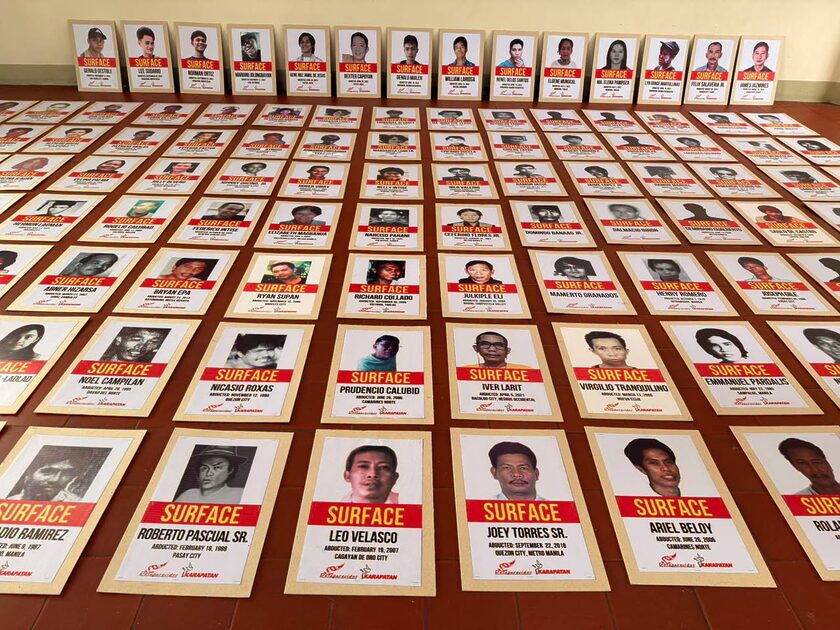
Both these political killings and terrorist bombings have claimed many lives. Table 1 shows the pattern of political killings.
Table 2 shows the loss of lives due to terrorist bombings.
What makes both appalling is that it claims as its victims unarmed, unaware, and innocent civilians. On the other hand, political killings are targeted, mainly directed against leaders, members, and supporters of left-leaning organizations.
The Arroyo government has condemned bombings and political killings and claimed that it is doing everything to put a stop to these heinous crimes. The Abu Sayyaf bandit group was supposedly reduced to an insignificant few and the Armed Forces of the Philippines (AFP) has time and again launched massive military operations in Mindanao purportedly to flush out terrorists. As for political killings, Press Secretary Ignacio Bunye professes to the Arroyo government’s sincerity in solving the killings by citing Macapagal-Arroyo’s public condemnation of the killings, her order to law enforcement agencies to solve 10 cases in 10 weeks, and her supposed plan to form an independent commission.
But both bombings and political killings continue in spite of government pronouncements.
The government is even suspected of being involved in at least two incidents in 2003, the March 4 Davao International Airport and the April 2 Sasa Wharf bombings, as well as other bombings in Mindanao at that time.
On the other hand, Karapatan and other human rights groups, progressive party list groups, Bayan Muna (People First), Anakpawis (Toiling Masses), and Gabriela, and militant organizations under the Bagong Alyansang Makabayan (Bayan or New Patriotic Alliance), whose members are the targets of political killings, accuse the Arroyo government of masterminding the killings as part of its counter-insurgency plan dubbed Oplan Bantay Laya.
The Commission on Human Rights, Amnesty International (AI), and various international groups that have conducted fact finding missions in the country blame the Arroyo government for having been directly involved, “or else have tolerated, acquiesced to, or been complicit in them.”
The August 15, 2006 report of AI read, “The common features in the methodology of the attacks, leftist profile of the victims, and an apparent culture of impunity shielding the perpetrators, has led Amnesty International to believe that the killings are not an unconnected series of criminal murders, armed robberies or unlawful killings. Rather they constitute a pattern of politically targeted extrajudicial executions taking place within the broader context of a continuing counter-insurgency campaign.”
The involvement of the Arroyo government in the killings is further validated by the fallacy of its arguments. PNP Deputy Director General Avelino Razon, who heads the task force formed by the government to investigate the killings, immediately pointed to killings allegedly committed by the Communist Party of the Philippines (CPP) and New People’s Army (NPA). But the most revealing reaction came from Executive Secretary Eduardo Ermita. He said that claims that the government was behind the killings was “a propaganda line” similar to the accusations made by AI in the 1970s against the Marcos regime, when he was still a military colonel. Ermita seems to forget that former President Marcos was internationally-known as a human rights violator and was even convicted by the Federal District Court of Honolulu in a class suit filed by relatives and victims of human rights violations.
 Save as PDF


0 Comments