
By signing the $434 million grant from the Millennium Challenge Corporation, the Aquino administration is committing to the same policies of deregulation, liberalization, and privatization that were vigorously pursued by the previous Arroyo administration.
By BENJIE OLIVEROS
Analysis
Bulatlat.com
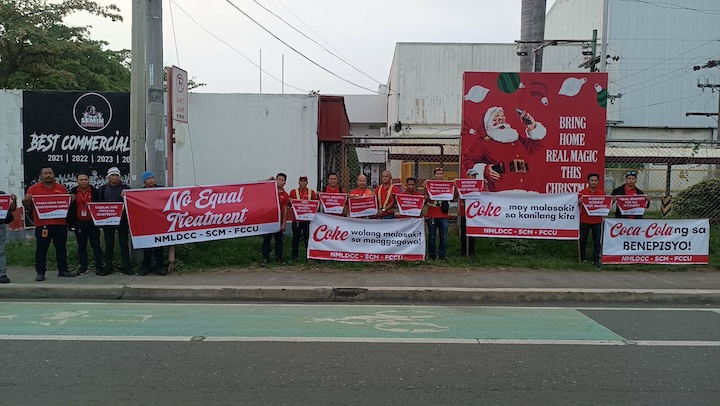
Malacañang has been trumpeting the success of the US trip of President Benigno Aquino III and in the process, downplaying the P25 million expense. Being cited as the fruits of the trip are the signing of the $434 million grant from the Millennium Challenge Corporation and the potential fresh investments from Coca Cola reportedly amounting to $1 billion to upgrade its facilities in the country, the $1 billion commitment of AES Corporation to double the capacity of its controversial Masinloc coal-fired power plant, and the $400 million in other investments for expansion projects by the world’s biggest multinational drug company Pfizer – which only recently gobbled up Wyeth – Hewlett-Packard and JP Morgan Chase. These supposedly would generate 43,000 jobs in the next three years.
There is a saying that nothing in this world is free. This applies to the commitments President Aquino received and gave during his US trip as well. According to Ibon Foundation, the Millennium Challenge Corporation (MCC) compact grant agreement did come with certain conditions namely, open trade, economic freedom, good governance, adherence to human rights, public investments in education and health care. Thus, part of the grant would go to the building of roads in Eastern Samar and the construction of clinics and schools in the poorest provinces. Well and good.
But for the donors, the most important conditions are free trade and economic freedom. It could be remembered that the conditional cash grant program began with the Arroyo administration and was supported by the International Monetary Fund, World Bank and Asian Development Bank even when it was widely believed to be involved in a lot of corruption scandals and was committing human rights violations.
By signing the compact grant agreement, the Aquino administration is committing to the same policies of deregulation, liberalization, and privatization that were vigorously pursued by the previous Arroyo administration. This entails continuing the process of removing tariffs, import quotas, and all restrictions to trade in goods and services; dismantling regulatory frameworks such as price control; removing restrictions to foreign investments, including controls over capital flight – which caused the Southeast asian financial crisis of 1997 – limitations to foreign equity, and the ban on foreign ownership of land; opening up all sectors of the economy to foreign investments including the finance and service sectors, such as education, communications and transportation; and privatizating essential government services and limiting government intervention in the economy in the name of fiscal austerity.
Essentially, with the signing of the MCC, the Aquino government commits to pursue the same neoliberal policies, which resulted in the current world economic crisis and the worsening of the domestic crisis.
As far as job generation is concerned, foreign investments hardly make a dent in the unemployment crisis in the country. According to Ibon Foundation, “Increasing FDI has actually been accompanied by increasing unemployment, increasing labor export, falling real wages, shrinking manufacturing and more volatile growth.” While the value of foreign investments almost doubled from $10 billion in 1995 to $19 billion in 2007, the period 2001-08 was also the worst period of recorded unemployment and underemployment in the country. The manufacturing sector has been shrinking. It lost 18,000 jobs in 2006, gained 4,000 jobs in 2007, lost another 137,000 jobs in 2008, and by July 2009 lost another 28,000 jobs. Aside from the closure of local companies, which lost out in the competition with multinational giants and cheap imports, multinational companies are also shedding jobs to maximize profits. For example, after the merger of Pfizer and Wyeth, it plans to shed 20,000 jobs by 2012. Pfizer has already started eliminating 8,000 jobs while Wyeth has been eliminating 5,000 jobs.
History has shown that the problems of poverty and unemployment, lack of capital and backwardness were never solved through grants, aids, and foreign investments. Neither was it solved by an intensification of trade because the country exports raw materials, minerals, semi-processed commodities, and low value added semi-manufactures and imports capital and consumer goods.
More than anything else, the US trip of President Aquino showed that he is bent on doing the same things. That is why his report of accomplishments brings back memories of the trips of former president Gloria Macapagal-Arroyo, minus the expensive dinners. (Bulatlat.com)
 Save as PDF





0 Comments
Trackbacks/Pingbacks