
Despite the advancements of AI technology, there is also the growing resistance.
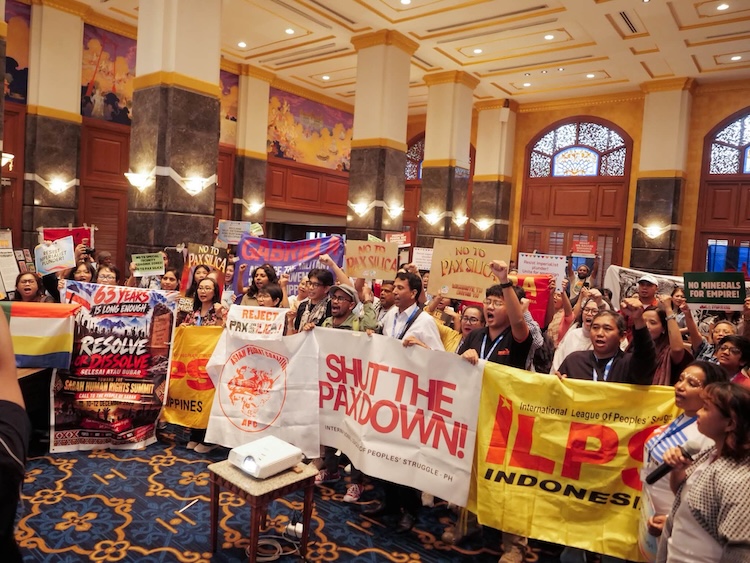
BANGKOK – Organizations from different parts of the world are now united against the Pax Silica Initiative to be signed by the United States and the Philippines in November. US President Donald Trump reportedly will visit the Philippines to sign the agreement.
“We are in a period of extreme conflict between two very powerful and imperialist countries and the US is trembling and shaking. We have to maintain that fervor of revolution, that ability to throw stones at them, to bring them down and to make sure that the US imperialist power is no more,” said Azra Sayeed, secretary-general of the International League of Peoples Struggles (ILPS) during an activity in Bangkok, Thailand dubbed “Shut the Pax Down: Resistance and Solidarity Against Imperialist Plunder” on October 14.
The International Monetary Fund and the World Bank (IMF-WB) held its annual meeting in Bangkok from October 12 to 18. Participants included central bank governors, economic policy makers and business leaders.
In a statement, the Campaigners of the Peoples Global Campaign (PGC) Against IMF and World expressed concern over IMF-WB’s push for new technologies, including the widespread adoption of artificial intelligence (AI) in Global South economies.
The group said that the “frantic race” for AI dominance intensified mining and extraction in resource-rich countries in the Global South. Transnational corporations are extracting rare earth elements (REEs) and other critical minerals to meet the growing demand for AI infrastructure. To secure control over the AI supply chain, countries like the US initiated the formation of Pax Silica and other similar formations.
“We know that imperialism is about world domination and control over resources. In the previous century, the rivalry among imperialist powers centered on oil because whoever controlled oil could wield significant influence over the military and the economy,” Arnold Padilla, secretary-general of ILPS-Philippines said during the event.
Now, he stressed, the battle is over critical minerals as whoever controls AI and the critical minerals needed to build its infrastructure could gain a significant advantage in dominating the world. “Essentially, that’s the battle now between the US and China. So, who will control this critical sector?”
This is why, Padilla said, the Philippines is up for a major battle to halt the signing of the US-led Pax Silica Initiative this year in time for the Asean Summit from November 16 to 18.
He said that AI is not just about the software that people use but also about weapons like drones “that can make decisions in actual battles without any human intervention.” He added that these sophisticated weapons will be made of minerals to be extracted from the Philippines.
Read: Critical minerals policy framework linked to Pax Silica?
Read: War and plunder: US imperialism in the Philippines
“Pax Silica is made up of 24 countries, of course, led by the US. And it’s a special coalition. Specifically chosen by the US because countries that belong to Pax Silica perform a specific specialized role because it’s about controlling the supply chain,” Padilla said. “We don’t have high technology, we don’t have the logistic network, we don’t have capital or energy. But what do we have? We have the critical minerals. So for us in the Philippines, this is all about plunder.”
Profit for the imperialist
Donna Denina, secretary-general of International Women’s Alliance (IWA), said that US Undersecretary of State for Economic Affairs Jacob Helberg, former tech executive and adviser tied to the controversial software firm Palantir, designed Pax Silica to give the US control over the global technology supply chain.
Palantir is a technology firm with clients from the Pentagon and foreign militaries including the Israeli government. But Denina said that Palantir is now expanding its influence beyond military tech into the health care sector.

In the US, she said that Palantir’s AI software is being used to manage hospital staffing and scheduling. This raised concerns among healthcare workers and prompted protests.
She said that more than 1,000 nurses from the National Nurses United union protested against healthcare institutions’ contracts with Palantir. “They are concerned that AI systems could replace human decision-making in the hospital. Nurses warn that relying on AI could reduce human oversight in decisions affecting patients’ care and well-being.”
She stressed that Palantir’s expansion in the United Kingdom’s National Health Service (NHS) was also protested by patients, health workers and the public.
Denina said that with the expansion of AI requires large data centers that consume vast amounts of land and water. She said that this is why some US states and cities banned or restricted the construction of data centers.
According to Data Center Watch, $64 billion of data center projects have been blocked or delayed due to local opposition.
“So not only is Palantir trying to monopolize war technology, it’s now expanding into health technology and trying to dominate AI tech firms to win contracts. And they suspect that Palantir will be the number one beneficiary for the Pax Silica agreement because of the types of technologies they can offer,” Denina said.
She added that despite the advancements of AI technology, there is also the growing resistance. “I think people in the US understand the impacts of the Pax Silica Agreement.”
“To support and facilitate more AI technology, there’s going to be more public funding spent on government contracts to support AI technology. Public spending that could be used towards supporting the local communities,” Denina said, adding that Bagong Alyasang Makabayan (Bayan) US chapter launched the Shut Down Pax Silica Campaign Network last September was joined by Filipino Americans in the US and other nationalities.
Read: US-wide campaign against Pax Silica launched
Sayeed called on different nations to show resistance against the US whose President is set to come to the Philippines next month.
“I recall reading Joma (Jose Maria Sison). He states that imperialism and feudalism are man-made social phenomena which are to exploit and oppress the people. They are plunderers of both humans and nature,” Sayeed said, adding that critical minerals are key to the industrial military complex as well.
This is why, she said, the US is trying to get hold of the supply chain. She said that the Philippines and Indonesia have critical minerals.
“We must all show up to make sure that he knows Asia. Whether we are in the Philippines or Indonesia or Pakistan or Nepal or India, we have to say, ‘you are not welcome,’” Sayeed said.
“Our resistance has to be fueled by the pain of the people. We fight for our people, we fight for our land, we fight for our destiny. So, that is who we are. And we will not forget.That come 16th of November, when he comes, he will be told you are not welcome across Asia and the Pacific. Let’s make this across Asia and the Pacific, not only the Philippines,” she added. (DAA)
 Save as PDF









0 Comments