
Second of three parts
Part 1: From unbridled globalization to controlling supply chains
Part 3: Luzon Economic Corridor and Pax Silica: Defense-industrial imperialist project
Under the Marcos Jr. regime, U.S. military involvement in the Philippines has expanded dramatically. In February 2023, during then-US Defense Secretary Lloyd Austin’s visit to Manila, the regime announced the opening of four new EDCA sites, including three locations facing Taiwan (Camilio Osias Naval Base and Lal-Lo airport in Cagayan, and Camp Melchor dela Cruz in Isabela) and one facing the South China Sea (Balabac Island in Palawan). Two months later, Marcos Jr. paid a visit to then-US President Joe Biden and announced the signing of the Bilateral Defense Guidelines, which updated the practical implementation of the 1951 Mutual Defense Treaty (MDT). The guidelines include maritime security cooperation, cybersecurity cooperation, and even space-related cooperation. It also reaffirmed that an armed attack in the Pacific, including anywhere in the South China Sea, on either country’s public vessels, aircraft, or armed forces would invoke the MDT.
The language, priorities, and focus on multi-domain awareness found in the Bilateral Defense Guidelines directly mirrored those in the Philippines’ National Security Policy (NSP) 2023–2028, released through Marcos Jr.’s Executive Order No. 37 in August 2023. The NSP shifted strategic priorities toward external defense, maritime security, and regional stability, explicitly identifying Taiwan (cross-strait relations) and the West Philippine Sea as primary or major concerns.
The US-designed and US-sponsored NSP introduced the Comprehensive Archipelagic Defense Concept (CADC), officially adopted by the AFP and the Department of National Defense (DND) in March 2024, facilitating a strategic pivot from internal counterinsurgency operations to a supposed external defense role, including securing the country’s exclusive economic zone (EEZ) and sea lanes. As such, the AFP’s modernization program increasingly emphasizes maritime (Philippine Navy) and air defense (Philippine Air Force) capabilities rather than internal counterinsurgency operations (Philippine Army). The CADC effectively integrates Philippine geography into U.S. regional military planning by developing a network of strategically located, forward-deployed military assets and facilities, as well as island strongholds such as Batanes and Palawan.
Subsequent agreements deepened this integration. The Philippine Security Sector Assistance Roadmap (PSSAR), announced in July 2024 during the so-called 2+2 Ministerial Dialogue of Philippine and U.S. defense and foreign affairs secretaries, aligned AFP modernization with long-term U.S. support and financing. The U.S. immediately allocated $500 million in Foreign Military Financing (FMF) for fiscal year 2024 to implement the PSSAR. It scaled up joint military exercises between the US and the Philippines, with over 500 held during the 2024-2026 timeframe, including the largest Balikatan exercise, which took place this year. It also accelerated investments in and the expansion of EDCA sites, with allocations of $128 million in 2025 and $144 million in 2026.
Legally-binding deal on higher-level military intel, advanced weapons
To fully implement the CADC and PSSAR, the U.S. and the Philippines signed a landmark military agreement in November 2024 – the General Security of Military Information Agreement (GSOMIA). It is a legally binding accord that establishes protocols, clearances, and guarantees ensuring that both countries will safeguard shared classified military intelligence. The GSOMIA facilitates the transfer of high-tech systems that rely on classified technical data (like advanced missiles or real-time satellite feeds) from the U.S. to the Philippines. It allows the Philippines to qualify for Foreign Military Sales (FMS) of advanced US weapons, including long-range precision strike missiles, advanced air defense systems, and naval strike weapons.
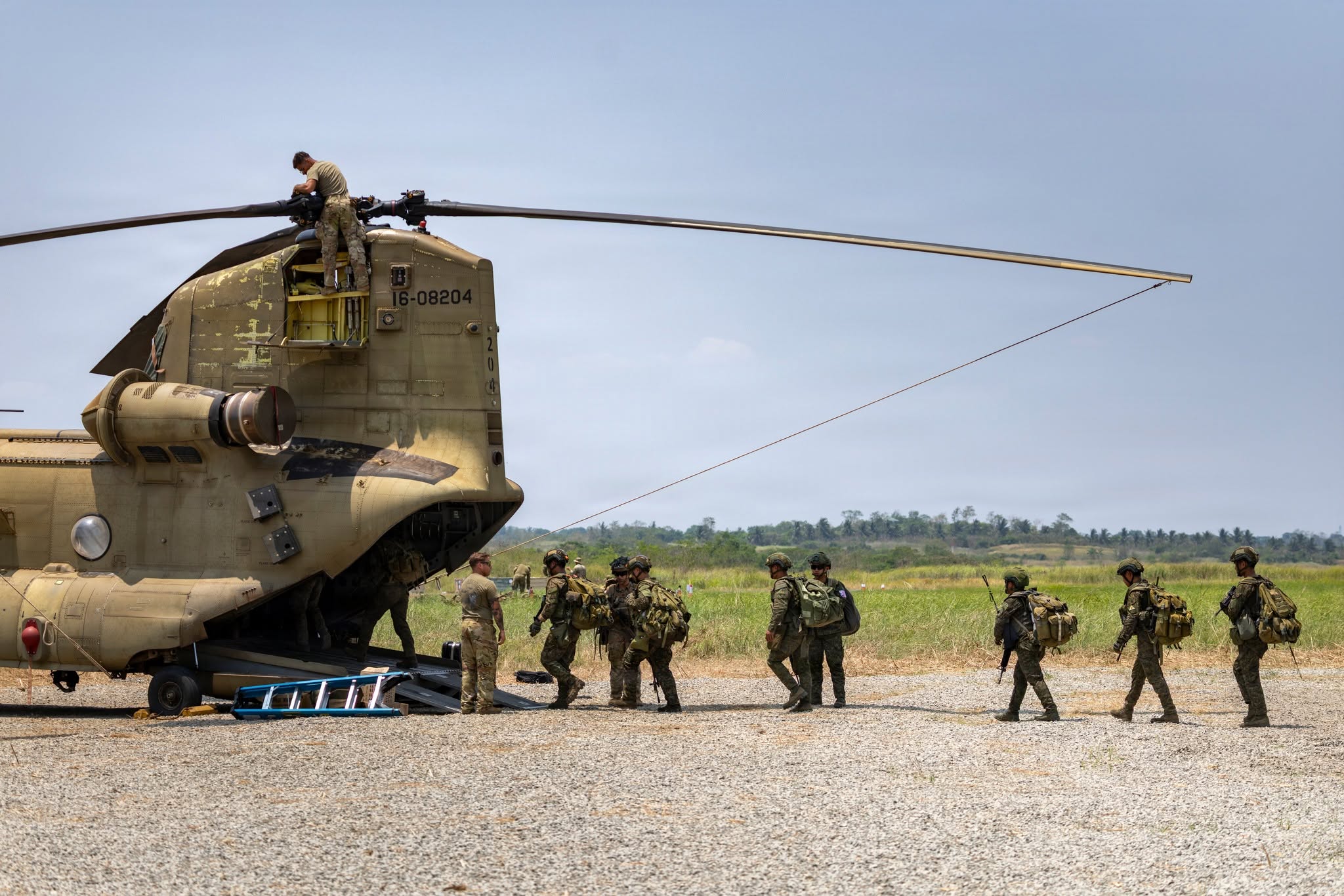
Between 2024 and 2026, through war exercises, the U.S. has already deployed some of these highly advanced systems on a rotational basis and showcased their capability. During Salaknib 2026 (April 15-16), the US Army, for the first time, live-fired 12 rockets using its High Mobility Artillery Rocket System (HIMARS) in Nueva Ecija. The Balikatan 2026 saw the first live-fire of a U.S. Tomahawk missile from the Tacloban Airport, traveling around 630 kilometers, to Fort Magsaysay in Nueva Ecija using its Typhon Mid-Range Capability (MRC). During Balikatan 2025, the U.S. deployed its Navy/Marine Expeditionary Ship Interdiction System (NMESIS) in Batanes and again in Cagayan in this year’s Balikatan. In 2024 and 2025, the US Marine Corps’ MQ-9A Reaper drones were deployed to Basa Air Base, an EDCA site in Pampanga, to patrol over the South China Sea. The U.S. is funding the expansion of the Basa Air Base, including hangars for unmanned aerial vehicles (UAVs) and a tactical operations center, possibly to accommodate additional deployment of its Reaper drones. With the GSOMIA in place, the U.S. can now position these advanced systems in the Philippines permanently rather than deploy them on a rotational basis.
Permanent, coordinated operational readiness
Under GSOMIA, the U.S. and the Philippines also established a Combined Coordination Center (CCC) at Camp Aguinaldo in November 2024. It is a joint command-and-control hub between the AFP and the US Indo-Pacific Command (INDOPACOM), designed to enable real-time intelligence sharing, joint planning, and interoperability for both militaries.
By 2025 and 2026, the process of deepening U.S. military intervention accelerated further. The establishment of Task Force Philippines in October 2025, under the framework of the 1951 MDT, created a direct operational linkage between the AFP and INDOPACOM. This unit handles strategic planning, including deploying advanced missile networks and aircraft during Balikatan exercises. The task force is designed to institutionalize a permanent, coordinated operational readiness. It covers “all domains of warfare,” meaning it plays a foundational role in coordinating high-end capabilities, such as advanced U.S. missile networks increasingly deployed in the Philippines, while also being heavily involved in day-to-day, real-time maritime domain awareness.
U.S. imperialism is allocating a massive amount of military funding to realize its agenda of transforming the Philippines into an effective platform for its power projection in the region and a vital part of its First Island Chain strategy to contain China. In December 2025, the US Congress passed the Philippines Enhanced Resilience Act (PERA), which is directly embedded in the FY 2026 National Defense Authorization Act (NDAA). PERA is the most intensive US defense investment in the Philippines since the Cold War, allocating up to $500 million annually in FMF from 2026 to 2030, totaling $2.5 billion over five fiscal years, specifically for long-range coastal defense capabilities, maritime domain awareness, and cybersecurity.
Just earlier this month, the U.S. Senate introduced the First Island Chain Security Cooperation Initiative (FISCI) as part of the FY 2027 NDAA. If approved, the FISCI will structurally bundle Taiwan and the Philippines into a single unified defense theater. It signals to Beijing that the U.S. views the defense of the Taiwan Strait and the South China Sea as geographically and operationally linked. This new initiative will grant the Philippines full eligibility for the same security assistance framework as Taiwan, allowing the country to access joint defense assistance, training, and equipment previously tailored specifically for Taiwan. The U.S. Senate is allocating $1 billion for the initiative, with an additional $1 billion earmarked to replace defense articles and reimburse defense services. FISCI also aims to accelerate the delivery of arms to the Philippines, Taiwan, Japan, and South Korea under the US FMS.
 Save as PDF





0 Comments