
That is why on Jan. 26, 1970, a large mass action of the youth and
students in front of the Philippine Congress had a ready-made issue:
they were there to confront Marcos on his state-of-the-nation address
to Congress, and to expose him for his continuing subservience to US
interests.
The area in front of Congress was swollen by the student youth and
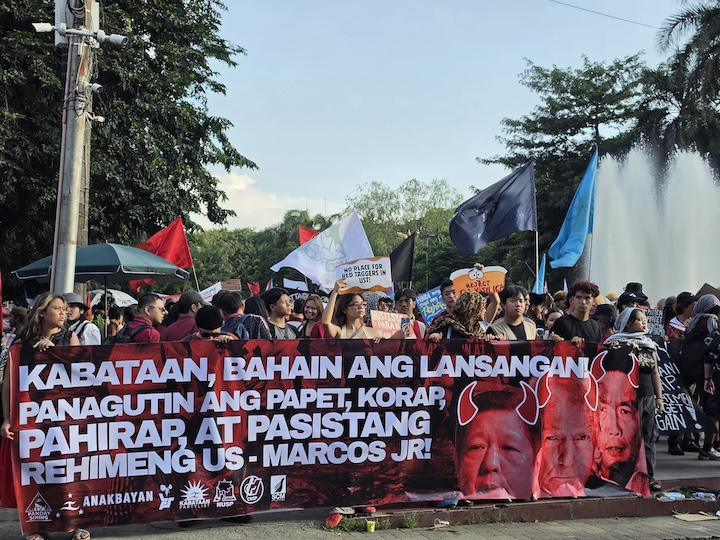
worker youth of Kabataang Makabayan (Patriotic Youth-KM) when Marcos, after his message to Congress exited nearby. Suddenly, some people flung a big papier-mache figure of a crocodile symbolizing the corrupt big bureaucrats, and a papier-mache representation of a coffin
symbolizing the death of national freedom, if my memory serves me
right. Then all hell broke loose. With truncheons, policemen and
military troops flailed every which way, hitting out at the radikal
kabataan (radical youth) of KM. Many were hurt and many were arrested.
Thus, a few days later, on Jan. 30, the youth and students of the KM
and other national democratic organizations went out on the streets
again, this time to demonstrate in front of Malacanang Palace to
protest the brutal dispersal of the Jan. 26 rally. This was a more
indignant rally than the first one, with the youth and students
standing their ground against the state’s armed goons’ truncheons,
teargas, water cannons and gunfire. The rally lasted until the
early-morning hours of Jan. 31, when the state goons had killed six of
the demonstrators and injured several hundreds of others.
To the marching youth, and to the people at large, this signalled
the growing desperation of the ruling system against the rising
masses. But undaunted by the mass killing of their six comrades, this
gave the awakened youth the impetus to expand to the provinces and to stage more demonstrations on an expanding scale. This process went on until the end of March – the Sigwa ng Unang Kwarto ng 1970, the FQS – and beyond.
The upsurge in the national democratic movement’s mass actions
served to expose and oppose a rotting system where US imperialism,
feudalism and bureaucrat capitalism held sway. The movement also
served to propagate the program of the national democratic movement
which was meant to replace the old and decaying one.
The mass movement was also a school to help prepare the cadres and
mass activists in confronting the enemy. In that sense, each mass
action was a learning process for the participants. In between those
marches, there were as well informal studies on revolutionary theory.
This was undertaken individually or by discussion groups (the
“DGs”). Education was further undertaken by integrating with the
worker and peasant masses.
If memory serves me right, the reading materials, or “RMs”, at
that time, included fresh documents of the CPP’s reestablishment
which repudiated Lavaite revisionism; the CPP’s Ang Bayan, Jose
Maria Sison’s Struggle for National Democracy, and Chairman Mao
Zedong’s selected writings and the Red Book. Five Golden Rays, which
inspired many people, came from Mao’s writings. Amado Guerrero’s
Philippine Society and Revolution was being prepared for printing.
The demonstrations had to increasingly confront the state’s forces
of coercion, especially those assembled in the PC Metropolitan Command (Metrocom), who used the gun almost as frequently as truncheons, teargas and water cannons. Thus, one could all the more easily comprehend Lenin’s State and Revolution, and accept armed revolution as the answer. And in integrating with, say, the worker masses, living with them and struggling with them at the picket line, one could more easily see their sense of exploitation and oppression, and their receptivity to scientific socialism.
The FQS was a time for courage. Increasingly confronting the
enemy’s guns (as in the case of Jan. 30-31), one drew strength and
guts from the synergy of the tens of thousands who were one’s
comrades, and those cheering you on. One dared to do anything!
“Makibaka! Huwag matakot!” (Fight on! Have no fear!) resounded
over and over again on the streets. And to help educate the masses,
and to put fear into the hearts of the enemy, “Ano ang sagot sa
martial law?” (What is our response to martial law?), “Digmaan,
digmaan, digmaang Bayan!” (War, war, people’s war!).
In the expansion nationwide, there was now a proliferation of new
mass organizations (MOs): Katipunan ng mga Samahang Manggagawa
(Kasama) and Pambansang Kilusan ng mga Manggagawa (Pakmap), among the workers; the Malayang Kilusang ng Bagong Kababaihan (Makibaka), among the women; the Samahan ng Demokratikong Kabataan (SDK) and the Katipunan ng Kabataang Demokratiko (KKD), among the youth; the Kapisanan ng mga Gurong Makabayan (Kaguma), among the teachers; the Christians for National Liberation (CNL), among the clergy and church people; Panulat para sa Kaunlaran ng Sambayanan (PAKSA), among literary people; the Nagkakaisang Progresibong Artista-Arkitekto (NPAA), among artists and architects; the Samahan ng mga Progresibong Propagandista (SPP), the League of Editors for a Democratic Society (LEADS) and the revived College Editors’ Guild of the Philippines (CEGP), among campus editors, and many others.
 Save as PDF



0 Comments