
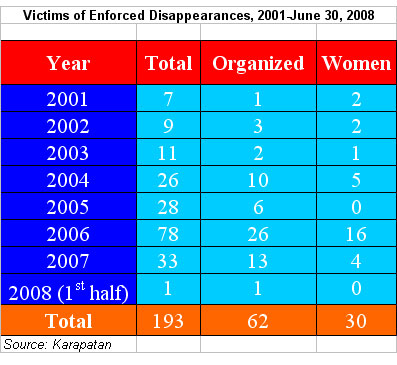
In the rates of both extrajudicial killings and enforced disappearances, there are marked escalations in 2005 and 2006, after which these crimes noticeably slowed down after these caught the attention of the local and international community. The European Union, Finland, the US Senate, US corporations such as Wal Mart, among others expressed concern over the spate of extrajudicial killings and enforced disappearances.
For relatives of the victims of extrajudicial killings and enforced disappearances, the drop in the rates of these human rights violations is not really something to be happy about.
“One one hand there is success in our campaign to stop the killings and disappearances, since there is a drop in their rates…but still, we are not happy because we haven’t seen our loved ones, and there is still no justice,” Santos said.
Among the legal remedies made available to the likes of Cadapan and Santos is the writ of amparo, the rules for which were approved by the Supreme Court in 2007.
A.M. No. 07-9-12-SC, which took effect on Oct. 24 last year, provides that the writ of amparo shall cover threats or actual cases of “extralegal killings” and enforced disappearances. The writ of amparo, among other things, seeks to provide protection for persons under threat of “extralegal killings” or enforced disappearances, as well as allows access to military and police camps where victims of enforced disappearances are suspected to be kept.
Several relatives of human rights victims, including Cadapan and Santos, have sought to avail of the writ of amparo.
The Court of Appeals, however, has recently dismissed four high-profile amparo petitions one after the other. These are the petitions for Jonas Burgos, Elizabeth Principe, Sherlyn Cadapan and Karen Empeño, and the Gumanoy sisters.
Jonas Burgos, a peasant organizer in Bulacan, was abducted by soldiers in a restaurant in Quezon City on April 28, 2007 and remains missing. The plate number of a van used in the abduction was traced to a vehicle impounded by the 56th Infantry Battalion of the Philippine Army.
Rose Ann and Fatima Gumanoy, daughters of slain peasant leader Eddie Gumanoy, were recently abducted by elements of the Intelligence Service of the Armed Forces of the Philippines (ISAFP) and placed under custody.
National Union of People’s Lawyers (NUPL) secretary-general Neri Javier Colmenares, in a recent legal analysis of which Bulatlat received a copy, criticized this series of decisions. Wrote Colmenares:
“These decisions unfortunately disregard the actual state of human rights in the Philippines today that has prompted the promulgation of the new remedy in the first place. This spate of decisions will only encourage the re-escalation of extrajudicial killings and enforced disappearances because of the continuing impunity which has unfortunately and unwittingly been judicially engendered further.”
Cadapan and Santos, in their interviews with Bulatlat, expressed similar observations.
“The perpetrators of extrajudicial killings and enforced disappearances will surely be emboldened to commit more of the same,” Cadapan said. “The rates may have decreased, but because of what has been happening in the Court of Appeals, we can be almost sure that the killings and disappearances will again escalate.”
“Yes, in a way it encourages more human rights violations, especially extrajudicial killings and enforced disappearances, because it shows the impunity of the perpetrators, because the Court of Appeals shows that the perpetrators need not answer for their crimes,” Santos said. (Bulatlat.com)
 Save as PDF





0 Comments