
The farmers of Hacienda Reyes – owned by the family of a town mayor in Quezon province – already bear the burden of an oppressive crop-sharing scheme. To make matters worse, when they ask for their rightful share their rights are violated, with not a little help from the military and the police.
BY DENNIS ESPADA
Bulatlat.com
“Di kami makapagtanim ng kahit kamoteng kahoy o mais para pagkain lang sana namin dahil bawal” We couldn’t plant cassava or corn for our food, for we are forbidden from doing so), says Nemia Cabradilla, a coconut farmer in Quezon.
She is the spokesperson of the Nagkakaisang Magsasaka sa Hacienda Reyes (Namar or United Farmers of Hacienda Reyes). Instead of food crops, she said the landowners want mahogany, narra and gemelina trees to be cultivated. “Sa partihan ng niyog, isa sa amin habang dalawa sa kanya. Sa halip na kami’y guminhawa sa aming pamumuhay, halos wala nang natitira sa amin” In the sharing of the coconut harvest, we get one while they get two. Far from earning enough to improve our lives, we have to make do with almost nothing), she said.
Hacienda Reyes (of the late Don Domingo Reyes) covers an estimated 12,000 to 16,000 hectares in the towns of Buenavista, San Andres and San Narciso, covering 10 barangays (villages) and 30 sub-villages.
With the Reyes family having a tight grip over the largest land, no agrarian reform program by past administrations has succeeded in breaking it up and allocating it to farmers.
Inequitable scheme
A research by the Katipunan ng mga Magbubukid sa Timog Katagalugan (Kasama-TK or Association of Peasants in Southern Tagalog) revealed that in Quezon alone, only 307 landlords control 71,898.50 has. of coconut lands, whose landholdings average around 234.20 has.
Hacienda Reyes is within the Bondoc Peninsula, which lies at the southern tip of Quezon province. Majority of its population are into subsistence farming (mainly coconut mono-cropping) and fishing.
Most coconut farmers are either farm workers or tenants on a 3-hectare farm on the average.
The 70-30 sharing system – which has been around since the 1960s – still prevails in the estate where the bigger share of the total harvest goes to the landowner while the tenant shoulders the production expenses. Tenants say copra costs a measly P9 ($0.18 at an exchange rate of $1=P49.82) per kilo which is hardly enough to send their children to school.
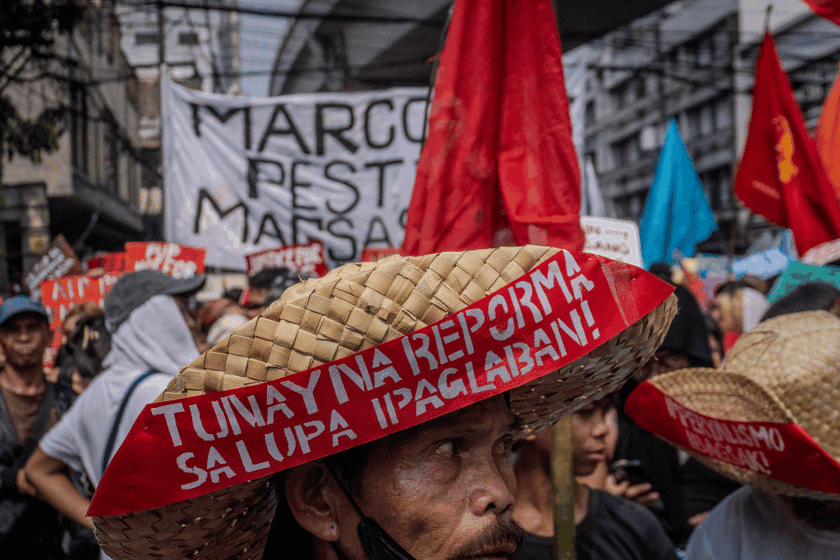
The peasants’ long quest for justice is always confronted with militarization. Kasama-TK reported that recent operations by the Philippine Army’s 74th Infantry Battalion purportedly to hunt down New People’s Army (NPA) rebels in the area have instead resulted in human rights violations.
Last Sept. 27, military soldiers arrested Jenina Caraballido, Anesia Orpinada, Tina Diocales, Danny Gullien and Gonzaldo Catampunang, all leaders of San Narciso Farmers’ Association and San Francisco Farmers’ Association of Barangay San Juan in San Narciso town.
They were brought to an Army camp in Barangay Ajos, Catanauan town and later detained at the San Narciso police station. The five were released upon posting bail worth P2,000 ($40.14) each.
Progress long overdue
To help alleviate poverty, the major demands of the tenant-farmers in Hacienda Reyes are to change the sharing system to 75-25 in favor of the tenants and to raise the price of copra to P17 ($0.34) per kilo.
In separate occasions, the farmers led by Namar have gone to the municipal hall to dialogue with the current landowner, San Narciso Mayor Victor Reyes.
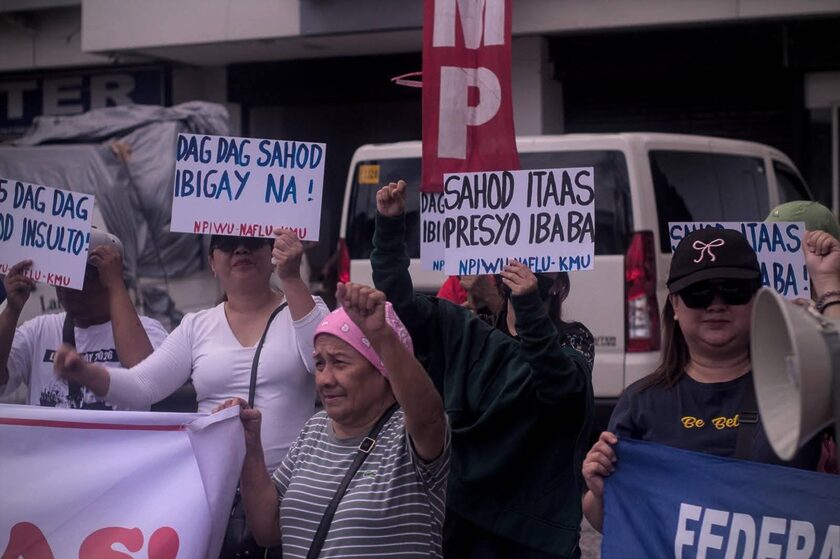
About 200 people who have marched and camped at Mayor Reyes’ mansion in Barangay Cotta in Lucena City were violently dispersed by elements of the Philippine National Police’s Special Weapons and Tactics Division (PNP-SWAT) last Oct. 21. Forty-eight farmers were illegally arrested. They were arbitrarily detained but were later released.
Janet Mahinay, a Namar leader, said they went there to ask for support after typhoon “Milenyo” devastated their crops. But in a radio interview, Mayor Reyes blamed his political opponents as being behind the peasant march.
Anakpawis (Toiling Masses) Rep. Rafael Mariano disagrees. He said Mayor Reyes is trying to conceal the real conflict in Hacienda Reyes, which is rooted in the continuing contradiction between a “despotic” landlord who holds “monopolistic control over the land” and the peasants’ anti-feudal struggle. (Bulatlat.com)
 Save as PDF


0 Comments