
Though some U.S. refineries are getting bogged down lately by a mismatch in grade of available crude and what they can refine (they prefer “sweet” crude, not “sour) and from sheer overwork, and despite so-called threats in Iran, the world is still reportedly awash in crude. Speculation, according to The Economist, is the main driving force of the unprecedented oil price hikes. On one estimate, it reported that $22 billion of net new investment has entered the oil futures market this year, $8 billion of it flooding in since the end of June. As a result, The Economist said, forward prices have risen by even more than spot prices.
Over the past 18 months, the world has seen oil prices shoot up from $40 to $50, then to $67 a barrel, and still, analysts have $70 and beyond in their sights. The biggest winners here are the oil companies –- the global oil companies and in the Philippines, the local oil companies which are mostly global oil majors’ subsidiaries and affiliates.
When oil was averaging $50 a barrel in 2004, it was already adjudged as “especially good for oil companies” by Forbes in its latest report on Global 500 corporations. Profits keep gushing, exclaimed Forbes, noting how “high oil prices pushed up revenues and earnings of energy companies.”
For example, the Royal Dutch Shell, despite widely publicized reserve trouble, saw its revenues increase by 33 percent and profits soar to 46 percent in 2004. Chevron and Total, which ranked Nos. 11 and 12 respectively in the top Global 500 companies, saw their revenues grow by 29 percent. Chevron’s profits leapt to an amazing 84 percent. British Petroleum (BP), No. 2 among global corporations, reported that their profits increased by 50 percent in 2004. Third-ranking ExxonMobil posted $25.3 billion in profits – a record-breaking amount of money for any global 500 company, according to Forbes.
Some of these global oil giants are in control of the Philippines’ Big Three (Shell, Caltex and Petron), and even of the newcomers like Total. Royal Dutch Shell controls Pilipinas Shell, ChevronTexaco owns Caltex Philippines, and Saudi Arabian Oil Company (Saudi Aramco), which has joint ventures with Royal Dutch Shell and ExxonMobil in refining and marketing of petroleum products, owns 40 percent of Petron Corporation.
Since these local oil companies are sourcing their crude oil from their affiliates or parent companies abroad, they can insulate themselves from the speculative ups and downs of international market trends in oil.
In fact, according to Ibon Philippines, these oil companies have been overpricing the public in the past years, as they took advantage of automatic price hikes allowed under a deregulated regime. In a review of pump prices from 2000 to 2004, Ibon found that oil products have been overpriced by a total of PhP3.68 per liter.
Consumer and Oil Price Watch chairman Raul Concepcion, meanwhile, has accused last week major oil companies Shell and Petron of “overrecovering” 35 centavos per liter of diesel and 14 centavos per liter of gasoline. These, even as Eastern Petroleum president Fernando Martinez was announcing that oil companies still have “under-recoveries of almost P2 for diesel and P3.50 for gasoline”, so price adjustments of 50 centavos per liter on a weekly basis are to be expected.
The Arroyo government’s measures to address the oil price hikes are ignoring these issues of “overrecovery.” In fact, it totally ignores the matter of local oil companies’ pricing, or these companies’ profitable local operations as a result of their extensive vertical integration with parent oil majors. Shunning regulation of the oil industry, the Arroyo administration simply resorts to moral suasion to convince the oil companies to raise pump prices weekly, in staggered basis, to reflect the increases in the world market.
Alternative measures
The Arroyo government sounds convinced that, as oft-repeated by Energy Undersecretary Abaya, rising oil prices are here to stay. In fact, Carlos Alindada, chairman of the Independent Review Committee on the Oil Deregulation Law, has recommended that the “DoE should accustom the public that we are now in a regime of high price increases.” The Independent Review Committee has also blamed devaluation and rising oil prices in the international market as the culprits in RP’s continuous oil price woes, and not the oil deregulation law.
But if the government will scrap the oil deregulation law, and serve as the central importer of crude oil, the government can minimize, or eliminate, the local oil companies’ practice of transfer pricing (or artificially jacking up the prices of imported crude oil), according to Ibon Philippines. The government can also seek out concessionary sellers of crude oil. Ibon Philippines also calls for developing alternative energy sources, but in a more systematic and thorough manner.
Sen. Franklin Drilon has also called on the Arroyo administration to regain control of Petron, one of the Big Three oil companies in the Philippines, so the government could directly determine and influence pump pricing.
All these proposals are dismissed, though, by the Arroyo government. In the case of oil deregulation law, its independent review committee has already declared it sound and good for the country’s oil industry. Asked in an oil conference about the billions of profits freely being reaped by oil companies, the review committee’s chairman, Carlos Alindada, replied that “the amount is not the only thing that matters, but the rate of return.”
The DoF has likewise dismissed Drilon’s proposal for Petron.
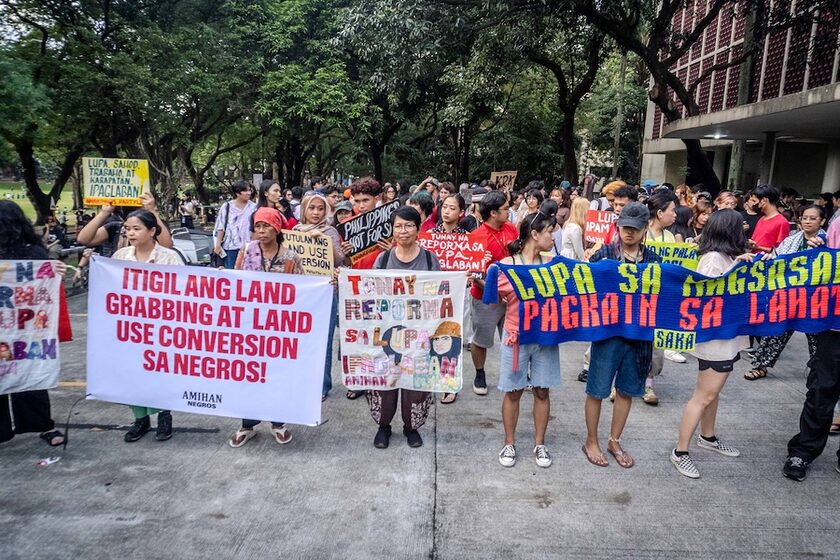
The looming oil crisis is shaping up into another likely trigger for Arroyo’s ouster. Militants have been picketing government offices and gas stations, branding the Oil Deregulation Law as “executioner” of Filipino consumers, and blasting Arroyo for not scrapping the law and taking charge of local pump pricing. Even as the Arroyo government contemplates imposing the value added tax on petroleum products, a move that would drastically hike oil prices further, protest actions are reportedly gearing up for a transport strike.
Even administration Sen. Joker Arroyo has observed that “while the provincial public could be indifferent to the impeachment, the national public will be outraged if prices keep going up.” Which is why even former staunch promoters of the EVAT law have started describing its potential implementation as “holocaust-like,” disastrous and “suicidal.”
The Arroyo administration is now angling for emergency powers, similar to strongman Ferdinand Marcos’ Batasang Pambansa 73 which was used during the oil crisis in early 1980s, to have more teeth in dealing with the looming oil price crisis. (Bulatlat.com)
 Save as PDF





0 Comments