OFWs seek to abolish overseas employment certificate
“We are asking the (Philippine Overseas Labor Office) to look into this and abolish the OEC because this is an added burden and cost to our fellow migrant workers.”

ADVERTISEMENT

“We are asking the (Philippine Overseas Labor Office) to look into this and abolish the OEC because this is an added burden and cost to our fellow migrant workers.”

The story of Danilo de Leon’s journey of leaving behind his family in the Philippines to work abroad is perhaps the story of most Filipino migrant workers, especially parents. He did so, after all, to provide a better future for his two children.

Various groups have joined the family of Mary Jane Veloso, a Filipina on death row, in urging Ferdinand Marcos Jr. to raise her case in his state visit to Indonesia, saying that she is long overdue for release.

A group of overseas Filipino workers challenged President-elect Ferdinand Marcos Jr. to act accordingly on the case of Filipina on death row Mary Jane Veloso.

Filipinos in Dubai endured long hours under the glare of the desert sun just to cast their votes on the first day of overseas absentee voting.
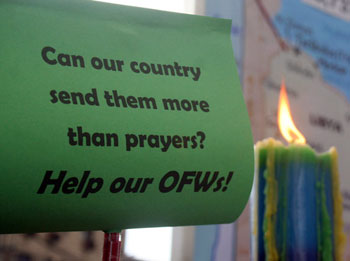
The families of the 29 Filipino seafarers stranded off the coast of Xiamen, China for almost five months now are asking the government to bring them home, saying that their pleas for help have fallen on deaf ears.
A migrant rights advocacy group has called on the Philippine government to provide due assistance to at least one million Filipinos facing threats of massive layoffs due to Saudization.

Hopeful overseas Filipino workers bound to Hong Kong are asking the government for help as the repeated travel bans and flight cancellations have left them stranded here in Metro Manila, putting their work abroad at risk as well.

Overseas Filipino workers and their families only saw broken campaign promises in the last five years of the Duterte presidency.

Nine overseas Filipino domestic workers are still reeling from inhumane treatment and various forms of violence that the International Labor Organization sought to eradicate more than 10 years ago.

A Filipina domestic helper stranded in Saudi Arabia is asking the government to have her repatriated so she can undergo hemorrhoid surgery.

For the past five years, all that 10 Filipino migrant workers stranded in Saudi Arabia can see are the ceilings and walls of their former employer’s housing facility. On most days, their spirits are dampened. Still, they hope to be reunited with their families someday.

After more than three decades of being one the country’s so-called modern day heroes, Estela’s family laments that they are now left on their own, without government aid provided to them.
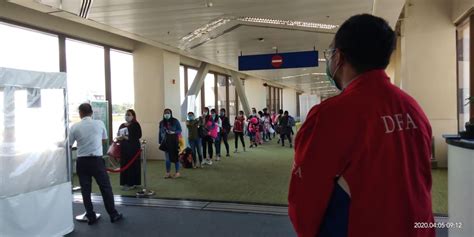
Migrante said that Duterte and Bello failed to address the government’s inefficiency in conducting and releasing the results of the PCR test which is what leads to prolonged quarantine periods and additional costs.

“Refunding the training fees in full is a financial relief to the eager claimants amid the impacts of the pandemic to their work and to the families they have left behind in the Philippines. This will also give them a sense of justice.”
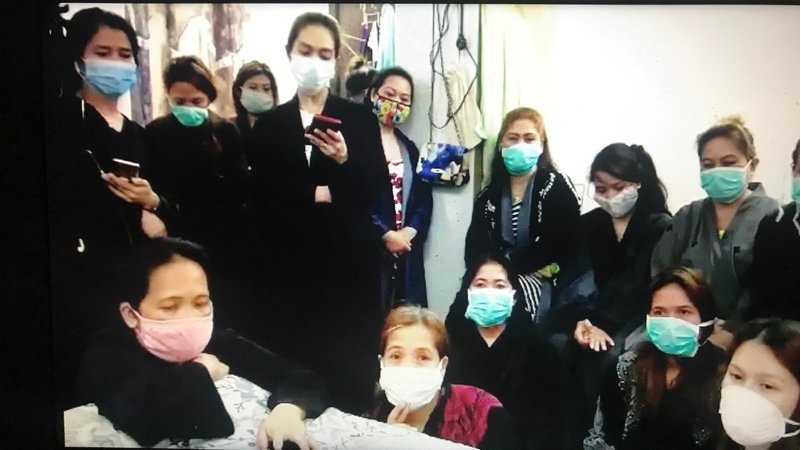
Migrante International said there are thousands of OFWs who lost their jobs who have yet to receive any financial assistance from the government.

While their employers benefit from social protections, they continue to expect their domestic workers to continue to serve not six but now seven days a week.
After a decade, Mary Jane Veloso will now be able to narrate her ordeal in full.

"The widespread corruption in the government is the reason why OFWs are strongly against the planned mandatory PhilHealth and premium rate hike. OFWs cannot entrust the government that their hard-earned money will benefit their families and the rest of the Filipino people."
Looking at history, one can say that state abandonment is very much the official disposition on which the labor export system is hinged. The Philippine government is fundamentally inclined to function simply as what sociologist Robyn Rodriguez calls a “labor brokerage state,” an institutional apparatus that facilitates Filipinos’ outward labor traffic.
A community of readers and supporters that help us sustain our operations through microdonations for as low as $1.