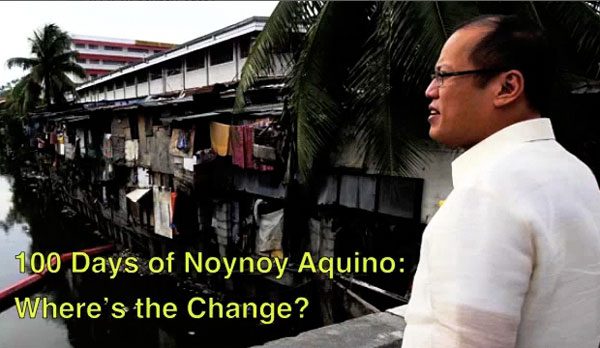
[Video] 100 Days of Noynoy Aquino: Where’s the Change?

[Video] Where’s the Change?

ADVERTISEMENT

[Video] Where’s the Change?

By JANESS ANN J. ELLAO
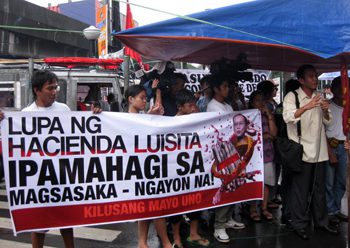
Farmers' group Kilusan ng Magbubukid ng Pilipinas said human rights violations and no land distribution even in haciendas under agrarian dispute characterize the first 100 days of the Aquino presidency.

By RONALYN V. OLEA
In March 2007, peasant leader Rene Quirante was imprisoned when criminal charges were filed against him by the military. Eventually, the case was dismissed. But on Oct. 1, around 2:00 a.m., soldiers of the 11th Infantry Battalion of the Philippine Army silenced him forever.

By JANESS ANN J. ELLAO
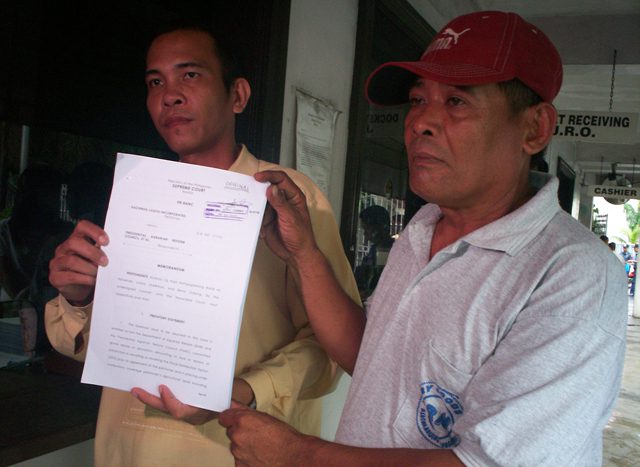
The 49-page document contained the farm workers' final stand regarding the agrarian dispute, which has been going on for more than a century already. "The justices would be able to find every answer to their questions (in this memorandum)," ULWU acting president and Ambala vice chairmain Lito Bais said.

By JANESS ANN J. ELLAO
When the lawyers of the Cojuangco family said, during the September 14 hearing, that they are open to land distribution if the price is right, the farm workers finally became hopeful. However, the Cojuangco clan denied it the very next day.

By JANESS ANN J. ELLAO
On a roller coaster ride in their struggle for the land they till, victory seems to be within grasp for the farm workers of Hacienda Luisita after the mediation panel announced that the land should be distributed, effectively revoking the Stock Distribution Option being imposed by the Cojuangco clan.

By JANESS ANN J. ELLAO
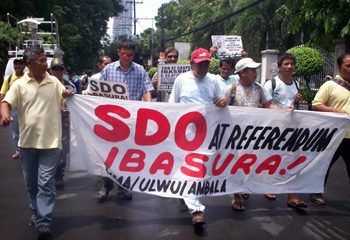
"The farm workers of Hacienda Luisita had been through so many referendums already. All of these were merely used by the Cojuangco family to deceive the farm workers and keep the land." – Lito Bais United Luisita Workers Union acting chairperson.
By JANESS ANN J. ELLAO, MARYA SALAMAT and ANNE MARXZE D. UMIL
After playing tough against the Luisita SDO during the first oral argument, the SC justices seemed to have "retreated" during the second hearing, forming a mediation panel for a "happy compromise." The peasants' desire for actual distribution of land, which the peasants say is no longer negotiable, should have been clear by now.

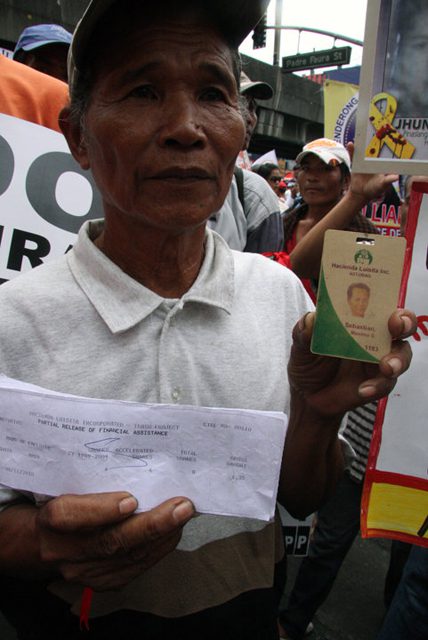
Luisita Farmers Trash 'Financial Assistance'
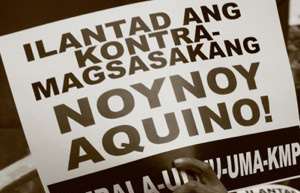
“The president cannot feign neutrality in this issue, for his silence and inaction will mean an implicit endorsement of the unjust compromise deal orchestrated by Cojuangco-owned HLI,” the Catholic Bishops’ Conference of the Philippines said in a statement.

By MARYA SALAMAT
Highlights in Wednesday’s oral arguments at the Supreme Court: Why farmers' shares of stocks were diluted, why new workers who were not party to the SDO in 1989 were given new shares, why shares were distributed within 15 years and not within three years as the law required, why the estate should not have been fragmented, why PARC’s revocation order is not a violation of the Bill of Rights, and why HLI’s failure to get DAR's "compliance certificate" could put SDO in trouble.
Watch Bulatlat's video primer on the SDO | Read more about the SDO

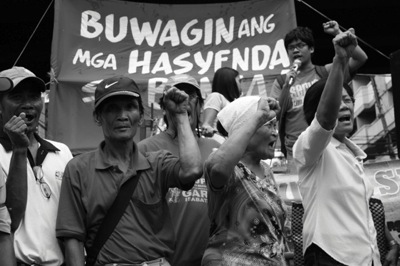
Maximo Sebastian found himself joining the day long protest rally in front of the Supreme Court (SC) last August 18. He was calling on the magistrates to reject Hacienda Luisita Inc’s (HLI) petition against the Presidential Agrarian Reform Council decision to junk the sugar estate’s stock distribution option (SDO) scheme.

A solidarity mass for the farm workers of Hacienda Luisita, officiated by Auxiliary Bishop of Manila Bp. Teodoro Bacani, was held in Sto. Domingo Church, Quezon City, on Tuesday --- a day before the Supreme Court will hold oral arguments on the petition for certiorari filed by the Hacienda Luisita Inc. (HLI) management against the 2005 resolution of the Presidential Agrarian Reform Council (PARC) and Department of Agrarian Reform revoking the SDO and ordering the distribution of land to the farm workers.

By RONALYN V. OLEA
Lawmaker says Supreme Court itself will be on trial. “The Hacienda Luisita land dispute is the first acid test of the Supreme Court under the Aquino administration. The Cojuangco-Aquinos have put the Supreme Court on trial here,” says Anakpawis Rep. Rafael Mariano.
That the plight of farm workers at Hacienda Luisita in Tarlac has already faded from the mainstream media limelight does not mean that there is now peace in the area. Last April 22, some 1,500 farm workers agreed to withdraw their shares in Hacienda Luisita, Inc. (HLI), demand that stock distribution option (SDO) be revoked and opt for land distribution instead.
Hacienda Luisita continues to be a battle ground, albeit unarmed, between residents and government troops. Since March 10, three companies of soldiers have been deployed here while angry people and village officials have been trying to drive them away by sheer grit and numbers.
A former member of the Yellow Army and supervisor of Hacienda Luisita who admitted to being one of campaigners for the Stock Distribution Option in 1989 tell how he did so -- and why they are going against it today.
Before the coffin bearing the remains of Tarlac City Councilor Abel Ladera, the ninth Hacienda Luisita martyr, was buried, it was opened for his family and barriomates one last time. It took however almost an hour before the people could finish their goodbye: young ones took pictures of him with their cellular phones; the older ones patted the coffin, with whispers of “Salamat po, salamat po” (thank you, thank you) while a woman asked with a break in her voice, “Bakit ka nila pinatay, wala na kaming kasama.” (Why did they kill you, we no longer have someone to help us.)
Holding a multi-colored bayong (plastic market bag), Mang Pering, a retired sugar farm worker, looked half-scared and half-exited. Inside his bayong was a panti (fish net made of nylon) and some dry clothes. He is on his way to the nearby river where he hopes to get some fish so his family would have something to eat for the day. But before he left, he said he only had one wish: “Sana hindi ako mahuli ng gwardya” (I hope the guard won’t catch me).
A community of readers and supporters that help us sustain our operations through microdonations for as low as $1.