

“We are not fools.”
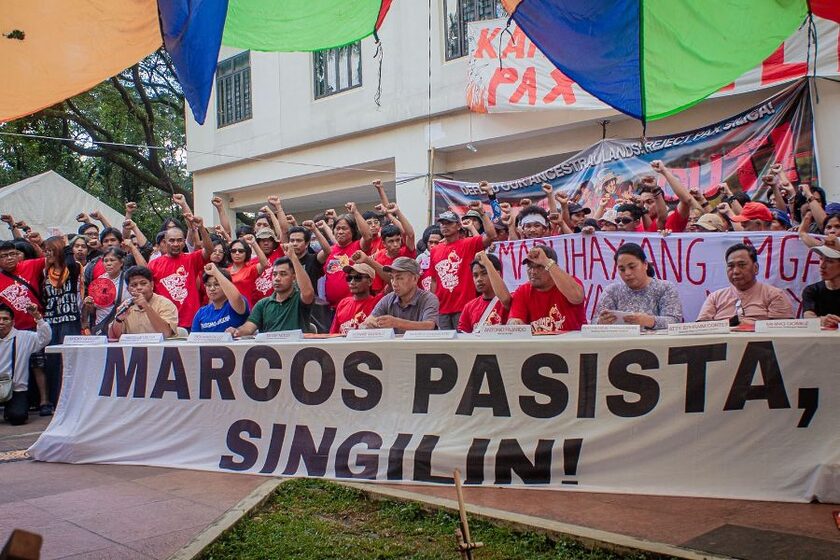
An Ayta community leader in Zambales faced military interrogation and surveillance days after joining protests against the US-backed Pax Silica initiative, raising concerns over the harassment of Indigenous Peoples defending their ancestral lands.
Orlino Lahut, also known as Tiyong Nilo, was visited by a military personnel identifying himself as Jasper Dalit in the afternoon of November 19 at the residence of an Ayta community elder in Iram, Zambales.
According to statements from Indigenous Peoples’ and environmental organizations, Dalit questioned Lahut about the community’s recent trip to Manila, including who organized their participation in the protests, who provided their “Reject Pax Silica” shirts, and how they financed their transportation.
Lahut was also reportedly coerced into completing a form requiring his personal information and organizational affiliations. Dalit threatened to return with additional personnel to question other community members.
The incident followed reports that unidentified men in civilian clothing monitored Ayta delegates during their journey home from Manila.
Katribu Youth Katipunan, Amihan National Federation of Peasant Women, and Kalikasan People’s Network for the Environment condemned the incident, describing it as an attempt to intimidate Indigenous communities exercising their right to protest.
Lahut rejected claims that the Ayta were manipulated by outsiders, asserting that their participation in the demonstrations was based on their own decision and opposition to projects threatening their ancestral domains. “We are not fools,” he said.
For the Ayta communities in Central Luzon, opposition to Pax Silica is premised on the threat to their ancestral lands, livelihoods, and environment.
The initiative, alongside the Marcos Jr. administration’s Luzon Economic Corridor, includes proposed developments such as the Aboitiz solar power project in Olongapo and an artificial intelligence and semiconductor hub in New Clark City, Tarlac.
These developments threaten ancestral and agricultural lands, including areas containing Ayta burial grounds. Amihan also warned that affected communities could face relocation to areas without adequate livelihood opportunities and access to clean water.
The proposed data hub is projected to consume up to 1.8 billion gallons of water annually and operate around the clock, with noise levels potentially reaching 105 decibels, according to Amihan.
Zenaida Soriano, national chairperson of Amihan, said that the initiative would further expose the country’s natural resources to foreign exploitation at the expense of Indigenous communities and farmers. “Pax Silica is a project of wealthy countries that will only destroy our lands, waters, and Indigenous communities.”
She stressed that the developments also threaten national food security, particularly with the planned expansion of the Luzon Economic Corridor across major ports in Luzon.
The harassment of Lahut coincided with another attack against an environmental defender, Lumad youth activist Mawing Pangadas, coordinator of Panalipdan Youth Davao. He was pursued by 10 to 12 suspected state agents wearing black clothing and caps along Upper Madapo Hills in Barangay 8-A, Davao City.
Read: Groups decry abduction attempt on Lumad youth activist in Davao City
Kalikasan condemned both incidents, stressing that these are growing threats against environmental defenders who oppose destructive projects and protect their communities’ land and resources.
For 13 consecutive years, the Philippines has been Asia’s deadliest country for environmental defenders, according to environmental organizations.
Despite this record, the Marcos Jr. administration has proposed a P9.75-billion ($152 million) budget for the National Task Force to End Local Communist Armed Conflict (NTF-ELCAC) in 2027, nearly P2 billion ($31 million) higher than its previous allocation.
Kalikasan criticized the proposed allocation, saying it results in sustained red-tagging, surveillance, and militarization instead of addressing the needs of communities affected by land grabbing and environmental destruction.
Soriano also condemned the continued military presence in rural communities, saying intimidation would not stop farmers and Indigenous Peoples from defending their rights. “Marcos and the military serve their master Donald Trump rather than the Filipino people. They resort to violence and intimidation to seize land and sell it to foreign businesses.”
The organizations called for an investigation into the attempted abduction of Pangadas and the prosecution of those responsible. They also demanded an end to the surveillance and harassment of Lahut and other Ayta leaders, as well as the withdrawal of military personnel from their communities.
Amihan vowed to continue opposing the exploitation of the country’s natural resources and the militarization of rural communities. (AMU, DAA)
 Save as PDF






0 Comments