
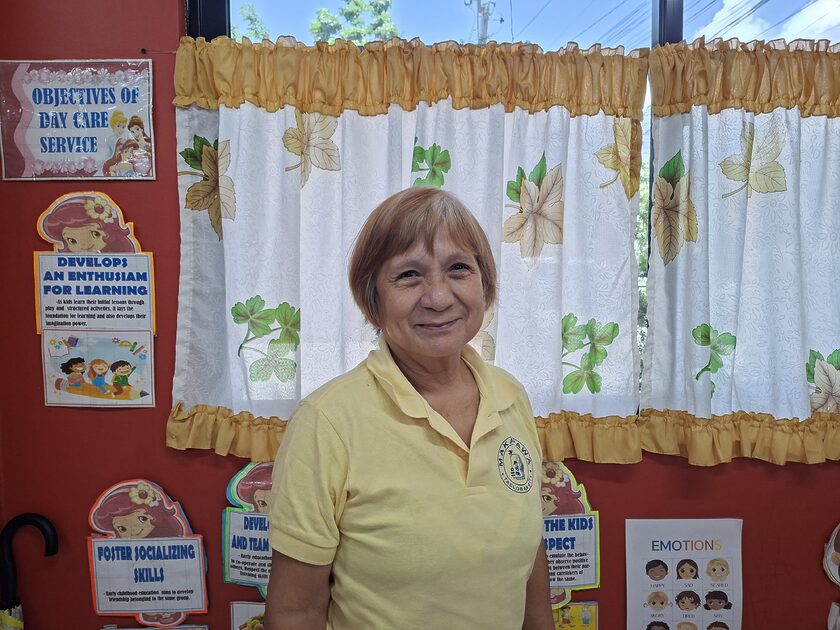
For Gilda Salazar Laag, if it were not for the mangroves, more would have been dead from Yolanda.
By Agatha Canape
CANCABATO BAY, Tacloban City – Gilda Salazar Laag, 69, recalled that she and her fellow volunteers found human bones when they tilled the muddy soil to plant the mangrove seedlings in Paraiso, which literally means paradise, a couple of months after supertyphoon Yolanda (international name: Haiyan) struck.
On November 8, 2013, the storm surge in Tacloban began at 7:00 a.m. and lasted until 8:30 am, submerging the city in seven meters of water. “Atop their roof, we witnessed the cries of people who could not be rescued as they were swept by the floods,” Laag said. The typhoon left thousands of people dead, millions displaced, and destroyed 90 percent of the city. Twenty-three people of those killed were from Paraiso.
Laag’s home was totally destroyed by the typhoon. Originally from Catarman, Northern Samar before she married, Laag was asked by her extended family to come back to her hometown while the city has yet to recover. She refused as her family feared losing whatever was left of their home. They rebuilt their home on the same lot where it was destroyed using materials that could be salvaged from its ruins.
Besides, Laag was tasked to deliver relief to households in the barangay. As a barangay health worker, she was knowledgeable about the number of people and needs of every household, and the nooks and crannies of the barangay.
Relief and recovery efforts bled into the next year. In February 2014, they were gathered by their barangay captain to look after the mangroves next.
Yolanda flattened the two-hectare mangrove forest in Paraiso to 0.2 hectares (2000 square meters), or merely 20 percent of the original coverage. The reforestation team started with 25 people, eight of whom were women.
The barangay, with support from international non-government organizations, procured seedlings which they potted, tended to in a nursery for two years before planting along the land at the edge of Cancabato Bay. Through their hands, they have grown back the mangrove forest and made it denser than before.
Paraiso was brought back to life. Between 2015 and 2018, approximately 30,000 mangrove seedlings were planted. According to a study, the mangrove forest cover in Paraiso increased by 80 percent compared to its pre-disaster state, expanding from two hectares to 5.18 hectares. In 2019, the Paraiso Mangrove Eco-Learning Park was opened to the public.
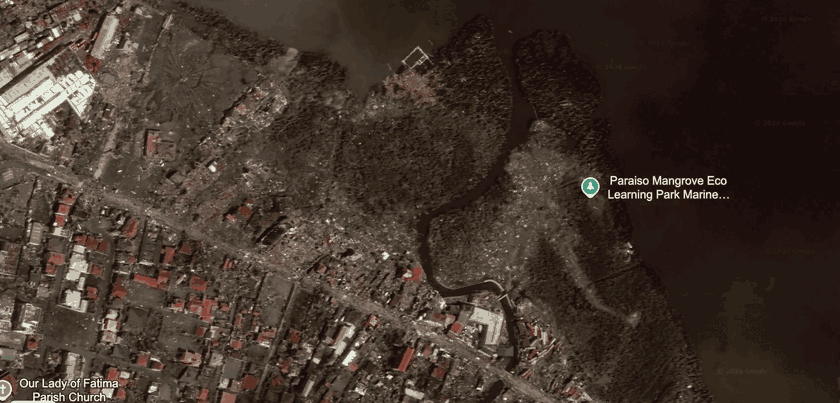
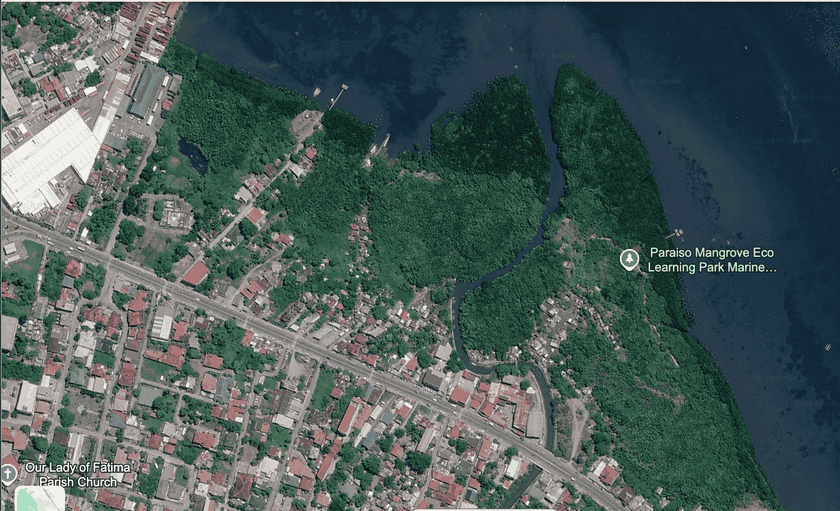
Satellite image of the mangrove forest in Paraiso, November 3, 2026. (Google Earth image)
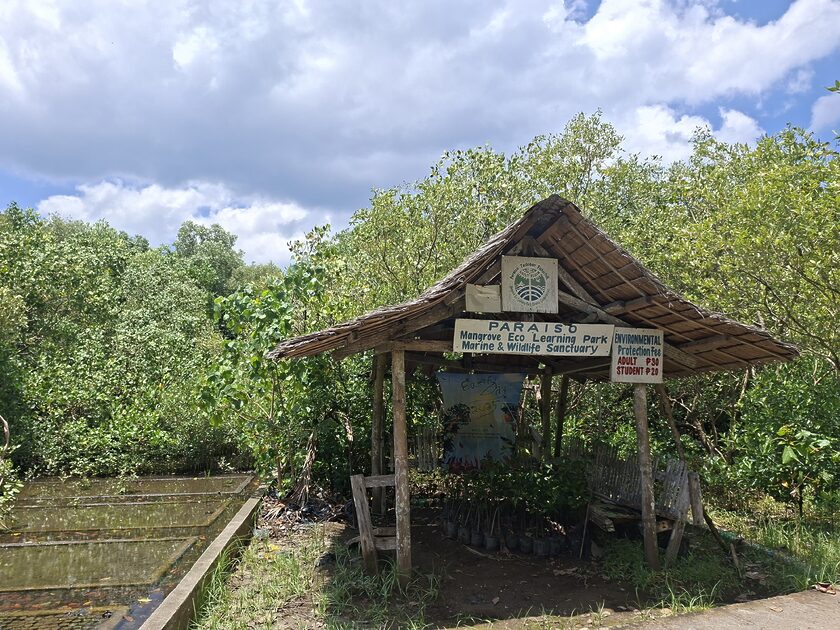
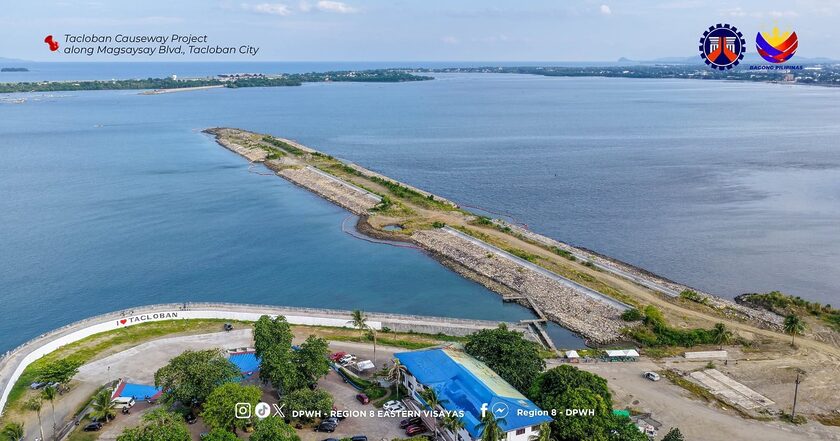
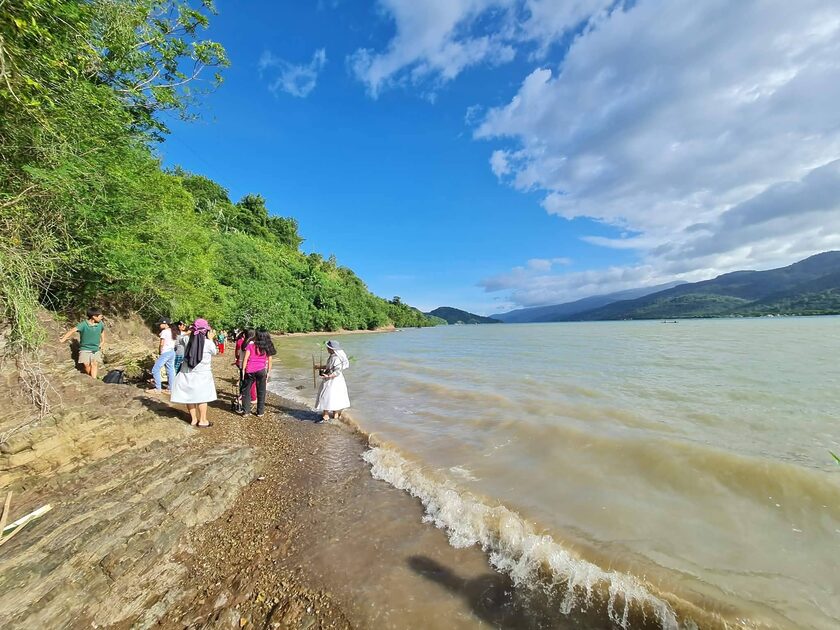
Today, Paraiso is once again under threat. The multi-billion Tacloban Causeway Project, a 2.55-kilometer road embankment and land reclamation project that will directly connect the Daniel Romualdez Airport to downtown Tacloban, is slowly killing the Cancabato Bay.
The city government, in the first volume of the Tacloban City Comprehensive Land Use Plan 2017-2025 claimed that the bay is “polluted and dying” to justify the plan to reclaim and convert it into a new central business district. (The plan has since been revised into a third volume where this claim has been removed. It is the only version available on the city government’s website.)
Rodolfo “Rudy” Delliva, 71, debunked the city government’s claims.
Delliva, a fisher who earns his living by catching blue swimming crabs, was among the volunteers who restored the mangroves along Cancabato Bay.
“Alive. It’s very much alive,” Delliva said about Cancabato Bay. He then enumerated the sea creatures he has known in the bay: danggit (rabbitfish/spinefoot), iito (catfish), lumong (whipfin silverbiddy), tamban (sardines), mangagat (mangrove red snapper), tingag (grouper), aguyong, kirawan, punaw (clam), and many more.
The efforts of the community for the past decade have revived the mangrove forest. One could hear the euphony of birds, which is not heard elsewhere in the city.
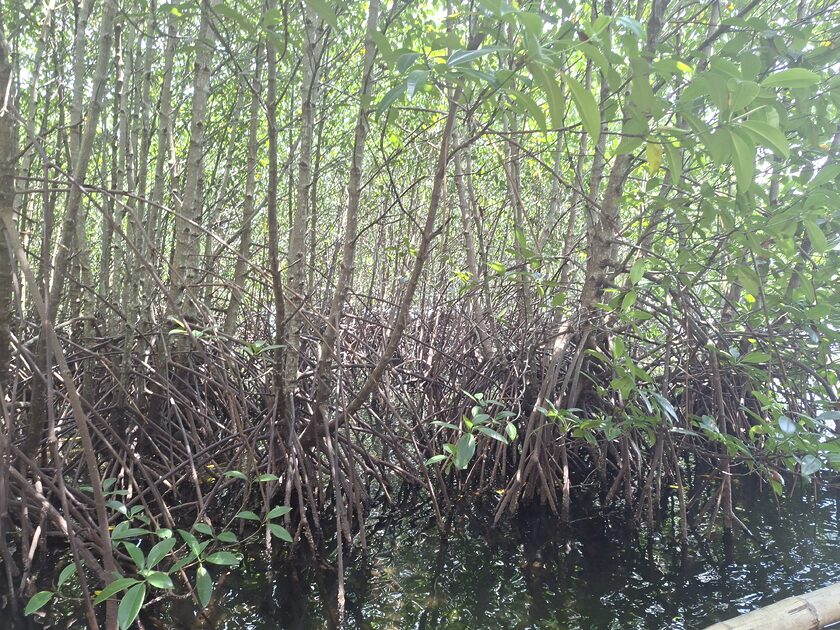
The trees are marked by their roots propped aboveground, taking up almost a third or even half of their heights. These are the Rhizophora apiculata, known as bakhaw lalaki, and the Avicennia marina, known as apiapi.
There are multiple mangrove species in the forest belonging to eight families: Avicennia, Combretaceae, Lythraceae, Meliaceae, Rhizophoraceae, Sonnertiaceae, Rubiaceae, but the bakhaw and apiapi outnumber the rest. The trees are planted too closely against standards but create a beautiful, entangled landscape.
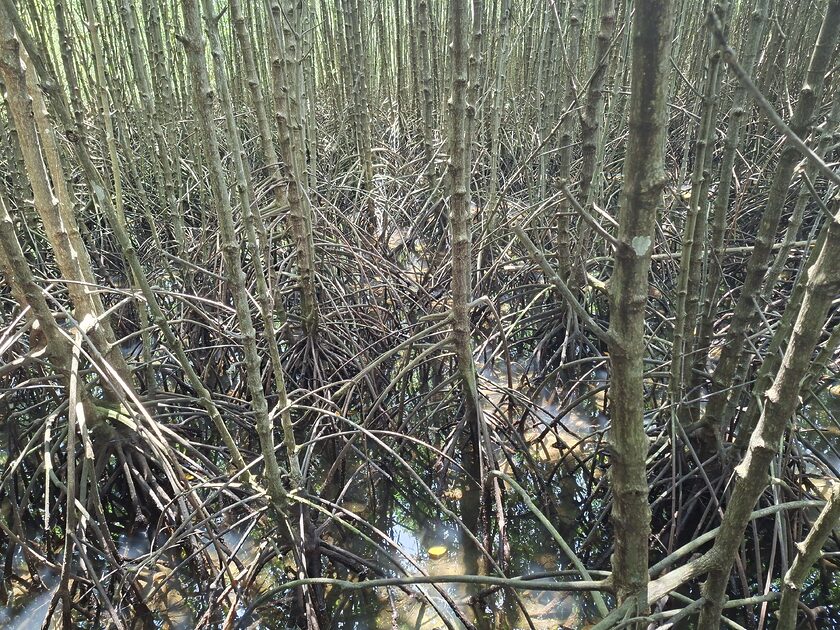
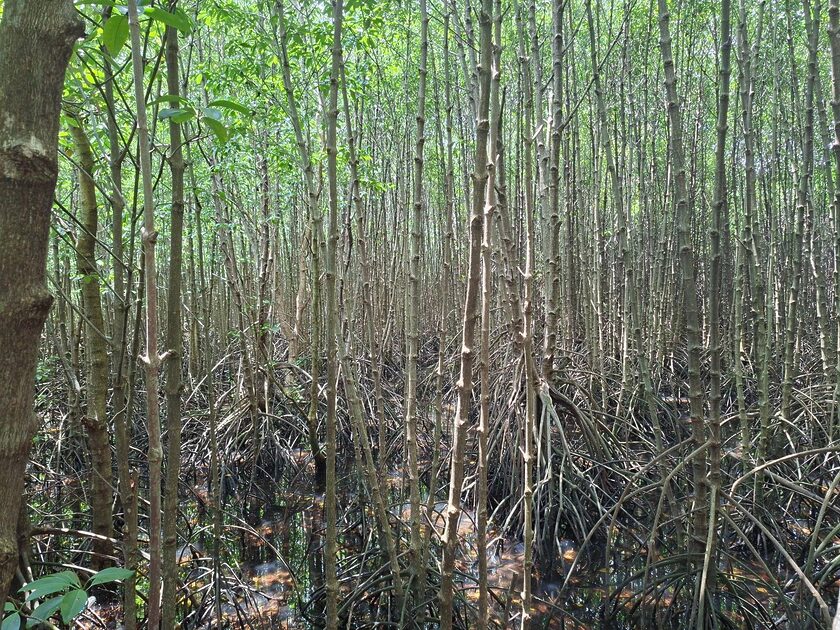
Inside the forest it feels cooler. One could hear the euphony of birds, which is not heard elsewhere in the city. The trees are marked by their roots propped aboveground, taking up almost a third or even half of their heights. The trees are planted too closely against standards but create a beautiful, entangled landscape. (Photo by Agatha Canape)
What the mangroves keep alive, the Tacloban Causeway Project is killing.
Delliva shared that fisherfolk’s catch from the bay has decreased since the construction of the causeway began.
“Before the causeway, when it rains, the saltwater [of the bay], naturally, gets diluted. Some sea creatures die. But it does not take much time for the bay to recover because the rainwater flows off and is replaced by saltwater from the sea,” he explained.
Now, he said, the causeway obstructs and constricts the water flow of the bay. Rainwater does not immediately flow off, and it takes longer for the bay to recover its salinity, killing off marine life.
Stewarding the mangroves
Delliva learned from experience the importance of preserving the mangroves.
Similar to Laag, Delliva built his house with his own hands from the scraps abound after Yolanda. He intended it to be only makeshift, but he has lived in it 13 years since. He was also scouted by their barangay captain to help with the reforestation. He had been living in Paraiso for a while then, but that was the first time that he paid attention to the mangroves and learned about them.
“Mangroves are habitat and spawning grounds for sea creatures. Fishes lay their eggs there. Blue swimming crabs live and also lay their eggs there. They also feed on the leaves of mangroves,” Delliva said.
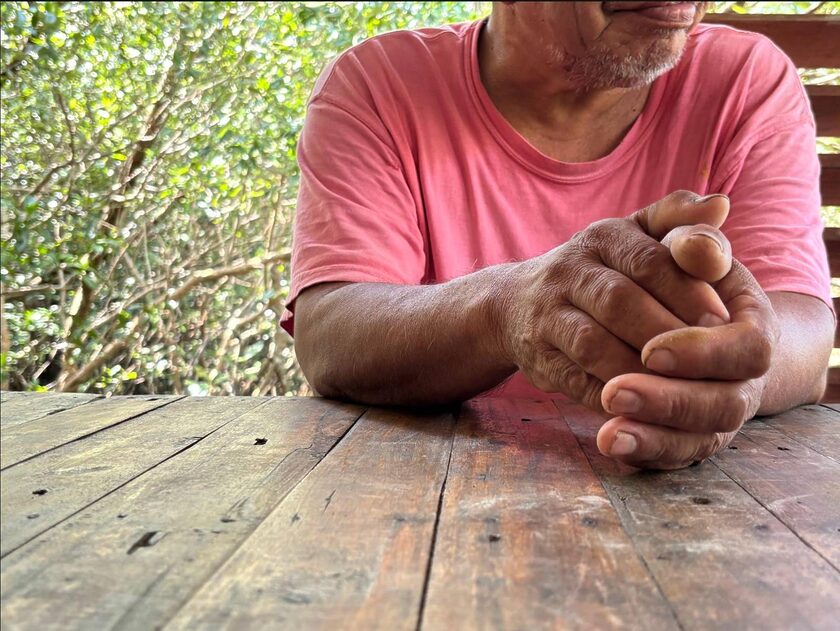
“Now, when tragedy strikes, or extreme weather comes, such as during Yolanda, mangroves help a lot,” Delliva told Bulatlat.
He added, “The boats and motorboats are carried along by the current. They do not hit the households [in the coastal areas] because of the mangroves. The sea cannot be stopped from rising and flooding the coast. But the waves can be subdued. Before they reach the coast, the waves lose their power. The waves are broken at the mangrove strip. That’s the job of mangroves,” he said.
For Laag, if it were not for the mangroves, more would have been dead from Yolanda.
Looming threats
Laag, Delliva and the rest of Paraiso folk are resisting “development projects” which would destroy the mangrove forest.
The Tacloban Causeway Project was among 21 projects in Leyte that were awarded to Sunwest, Inc., which was founded by former Ako Bicol Partylist Representative Elizaldy “Zaldy” Co, between 2020-2025, coinciding with his allyship with the province’s 1st district Representative, Martin Romualdez. They are co-accused for a plunder charge for allegedly receiving kickbacks worth over P7 billion (USD 110.2 million).
Co resigned from congress in September 2025 after being accused of corrupting public funds for flood control projects. He is currently a fugitive abroad facing multiple charges of plunder, graft, and malversation. Some of the criminal charges against him are directly linked to irregularities related to a Sunwest, Inc.-contracted flood control project in Naujan, Oriental Mindoro.
In September 2026, the Department of Public Works and Highways (DPWH) affirmed that it will continue constructing the causeway. Construction halted last year after the corruption issue involving Co, Romualdez, and other high-level public officials was exposed. The Commission on Audit and DPWH will inspect the project to determine which “portions of the project may be continued and subsequently subjected to re-bidding or proposal for future funding.”
The DPWH issued this statement despite outstanding concerns about the impacts of the causeway to Cancabato. The Environmental Impact Assessment and Environmental Compliance Certificate of the project have not been disclosed despite requests from local advocates.
Advocates are planning to file a writ of kalikasan to halt the causeway project and uphold the status of the Cancabato Bay as a marine protected and fishery reservation area.
“If we were to decide, we do not want to proceed with the project,” Laag said. “The government did not consult us. They just decided on their own.”
Further disruption
It is not only the causeway that has affected the lives of the people in the community but also military exercises.
Last May 5, the lives of the fisherfolk in the San Jose district were disrupted by the firing of the Tomahawk missile using the Typhon missile system from Tacloban City Airport to a target 600 kilometers away at Fort Magsaysay in Laur, Nueva Ecija.
The fisherfolk communities near the airport were abruptly barred from sailing in San Pedro Bay a few days before the firing of the missile without ample time to prepare, nor sufficient support to compensate for the loss of income.
The missile firing was part of the largest US-Philippines Balikatan war exercises involving around 17,000 troops, held between April-May across the country, with Tacloban as one of the host cities.
Balikatan has normalized military presence in the fisherfolk communities along Cancabato, and the rest of Tacloban. It was followed by the US Navy-led Pacific Partnership held on September 18-29, which deployed military forces across the city and nearby municipalities on the premise of humanitarian and disaster preparedness missions. Besides the US and Philippines, hundreds of armed forces from Canada, Germany, Japan, New Zealand, and the United Kingdom also joined.
Military delegates of the Pacific Partnership performed various innocuous tasks such as building and repairing school and water facilities, medical missions, and even playing live music, whitewashing militarization through services that should have been provided by the Philippine government.
These efforts are part of the escalation of US-led militarization in the country and the rest of the Asia Pacific to project its power against China.
Paraiso’s dreams
Amid all these threats, the people of Paraiso only yearn for a simple life.
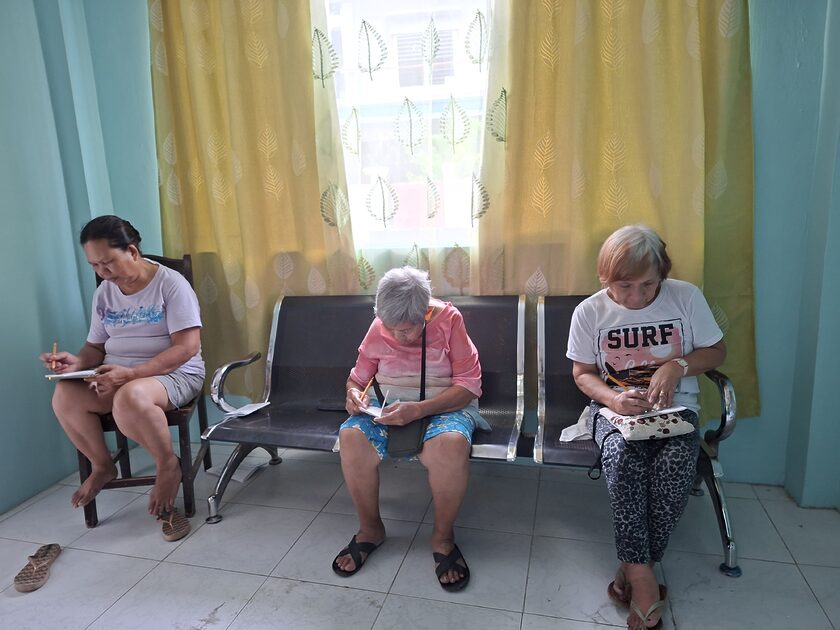
In a zine-making activity, three elderly women volunteers of the Paraiso Eco-Learning Mangrove Park–Laag, Mila Roca, 74, and Nati Pacunla, 64–wrote and talked about their dreams for their community. All three were barangay health workers who served their community for most of their lives.
After Yolanda, they were all recruited to clean the mangrove area, prepare the seedlings in a nursery, and finally, plant them. They were proud that many came to visit their park, and worried about the lack of finance to support its maintenance. Roca shared her dream of sprucing up the mangrove park into a tourist spot worthy of Tacloban.
The fight for our land and resources are led by the likes of the elderly volunteers of Paraiso. With little support, they have managed to restore and grow the mangroves in the city from the devastation of Typhoon Yolanda, and sustain the life of the bay that has fed and sheltered their communities for generations.
But the precarious state of the park also tells that community-led efforts are unsustainable in the long-term without systematized support. The challenge to the government to redo its priorities remains. (AMU, RVO)
Disclaimer: This story was produced through a grant from Oxfam Pilipinas’ Patas na Bukas Media Fellowship.
 Save as PDF






0 Comments