
“The biological aspect includes medicines and genetics,” Del Valle said. “But psychosocial factors—the social determinants of health—also affect us. If we improve education, if people have jobs, and communities can support them, these all contribute to mental health.”
Trigger warning: Mentions of suicide
By Kasheena Camacho
Bulatlat.com
MANILA — For Filipinos experiencing mental health crises, long waiting periods for free mental health consultations continue to hinder their access to care, forcing some of them to seek costly private treatment.
For March Lavela, 24, deciding to seek professional help came after months of grief, mounting family responsibilities, and worsening panic attacks. “The turning point for me was when the pressure built up so much that my body couldn’t handle it anymore,” Lavela said.
He said the panic attacks began during online thesis classes, where repeated confrontations with a professor became overwhelming. The anxiety persisted even outside the classroom, with merely hearing the professor’s name triggering panic.
“I knew it was time to ask for help when I started thinking about death and killing myself,” he said. “…[R]ealizing my mind was going to that dark place made me see that I couldn’t fight this on my own anymore.”
Unable to afford private psychiatric consultations, Lavela sought free mental health services. He booked consultations with both the Philippine General Hospital (PGH) and the National Center for Mental Health (NCMH). The available schedules, however, were months away.
“I decided to just walk in at NCMH because I knew I couldn’t wait for a far-off online appointment date,” he said. “I felt like if I waited that long, I might already be gone.”
At the NCMH, he disclosed to hospital personnel that he had been experiencing suicidal thoughts. “They assisted me through the whole process once I walked into the hospital,” he said.
Lavela’s experience mirrors a broader challenge confronting the country’s mental healthcare system.
Jem Curtny B. Narboneta, 21, also agonized over the waiting period to access care.
Narboneta, a psychology student, said she initially spent around P11,000 ($181) on several online psychological consultation platforms in search of answers.
She also contacted around 15 to 20 emergency hotlines she found online but said none responded.
Her mother later accompanied her to NCMH for free consultation. Instead of receiving immediate care, they were advised to secure an online appointment. Narboneta said the earliest available schedule was nearly a year away.
“Obviously I couldn’t wait that long because I’d be long gone if I were to wait a year,” she said.
Unable to wait, she then sought consultation with a private psychiatric facility despite the additional cost.
“It greatly affected my well-being because I needed mental health consultation that time,” she said. “To find out I had to wait a year made me think of all the people who finally mustered the courage to seek help only to discover mental health services weren’t as accessible as they thought.”
Demand outpacing capacity
Lavela and Narboneta are among the thousands of Filipinos seeking professional mental health services in the past years.
In an online interview with Bulatlat, Dr. Teresa Rosalie D. del Valle, a medical specialist IV at the NCMH, said that consultations have increased significantly in recent years.
“The pandemic heightened public awareness of mental health,” Del Valle said.
The increase in demand, however, has outpaced the country’s available mental health workforce, according to both Del Valle and international data.
According to the World Health Organization’s Mental Health Atlas 2024, the Philippines has only 3.9 mental health workers for every 100,000 population, including 0.2 psychiatrists, 0.3 psychologists, 0.7 mental health nurses, 1.1 social workers, and 1.6 other mental health workers per 100,000 population.
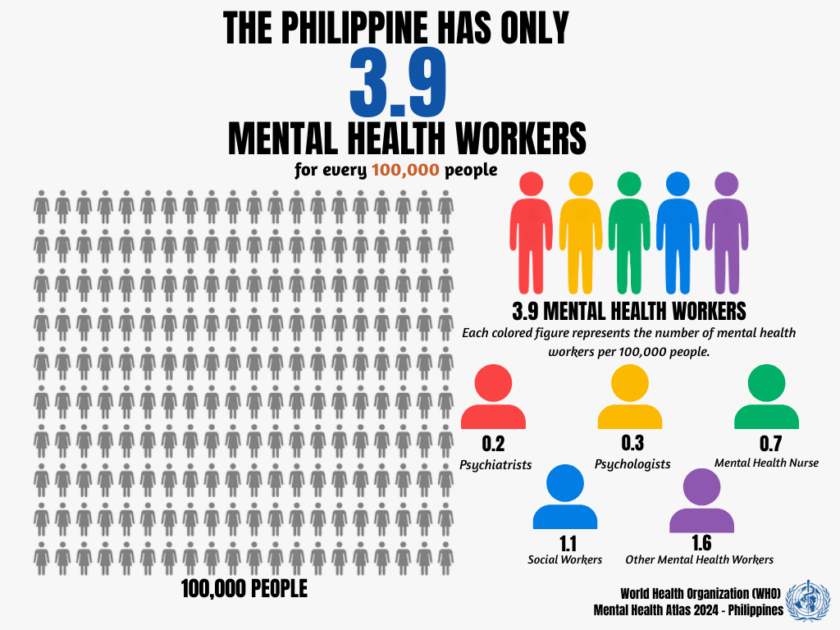
The report also recorded one specialized mental hospital, 22 psychiatric units in general hospitals, and 1,362 community-based outpatient mental health facilities nationwide.
Del Valle said the current number of psychiatrists remains insufficient to keep up with the growing number of patients seeking care.
“At present, we have around 600 to 700 [psychiatrists], so that cannot meet the increasing number of service users in need of mental health services,” she said.
She stressed, however, that psychiatrists are only one part of the mental health workforce.
“We also have psychologists who can provide psychological first aid and therapy,” Del Valle said.
She added that not every person seeking mental healthcare immediately requires the services of a psychiatrist.
“There is a proper referral network,” she said. “Not everyone needs the specialty.”
Depending on a patient’s condition, Del Valle said individuals may first receive care from psychologists, guidance counselors, social workers, nurses and trained primary care physicians before referral to a psychiatrist when specialized treatment is needed.
Efforts to expand access
While challenges remain, Del Valle said efforts have been made to expand access to mental healthcare beyond specialty hospitals.
She said the Department of Health has trained primary care physicians through the World Health Organization’s Mental Health Gap Action Programme (mhGAP) to identify and manage common mental health conditions, allowing patients to receive care closer to their communities before being referred to specialists when necessary.
These efforts complement Republic Act No. 11036, or the Mental Health Act of 2018, which institutionalized mental health services within the country’s healthcare system. Mental health services have also been included in PhilHealth benefit packages for selected psychiatric conditions, while NCMH continues to provide online follow-up consultations and operate the 1553 Crisis Hotline.
Still, Del Valle emphasized that improving access requires more than expanding services.
“Mental health is not just biological,” she said, explaining that NCMH follows a biopsychosocial-spiritual framework that recognizes the role of medication, psychological support, social conditions, and spiritual well-being in a person’s recovery.
“The biological aspect includes medicines and genetics,” Del Valle said. “But psychosocial factors—the social determinants of health—also affect us. If we improve education, if people have jobs, and communities can support them, these all contribute to mental health.”
‘When someone asks for help’
For Lavela, improving mental health services means ensuring that people receive help the moment they decide to seek it.
He said government hospitals should strengthen the public mental health workforce and provide clearer information about available services, including how patients can access consultations.
“When someone finally asks for help, especially in a case like this, they need to be assisted immediately,” Lavela said. “We need more doctors in public hospitals. The waiting lines are incredibly long simply because there aren’t enough doctors to cater to everyone.”
Lavela also urged hospitals to improve the availability of information online.
“I understand why pictures or videos aren’t allowed because of patient privacy,” he said. “But clearer information from hospitals themselves would help more people know that help is available.”
Narboneta likewise said long waiting periods can discourage people who are already struggling from pursuing treatment.
“It’s not just a mere 30 minutes,” he said. “It’s a whole year of waiting time that greatly affects everyone who just wanted to have a free consultation.”
He said reducing waiting times, expanding free consultations, and making therapy and medicines more accessible would encourage more people to seek professional help before their condition worsens.
Looking back, Narboneta hopes no one else will have to choose between paying for treatment they cannot afford and waiting months for free care.
“You deserve to be seen, to be heard, and to be treated fairly,” she said.
For Lavela and Narboneta, deciding to seek professional help was already one of the hardest steps. They said the country’s mental healthcare system should ensure that asking for help is met with timely, accessible and compassionate care—not months of waiting. (AMU, RVO)
If you or someone you know needs immediate help, free and confidential 24/7 support is available:
- National Center for Mental Health (NCMH) Crisis Hotline: Call 1553 (toll-free Luzon-wide landlines) or 0919-057-1553.
- In Touch Crisis Line: Call +63 2 8893 7603 or 0917-800-1123 / 0922-893-8944.
- Hopeline Philippines: Call 2919 (Globe/TM) or 0917-558-4673
 Save as PDF

0 Comments