
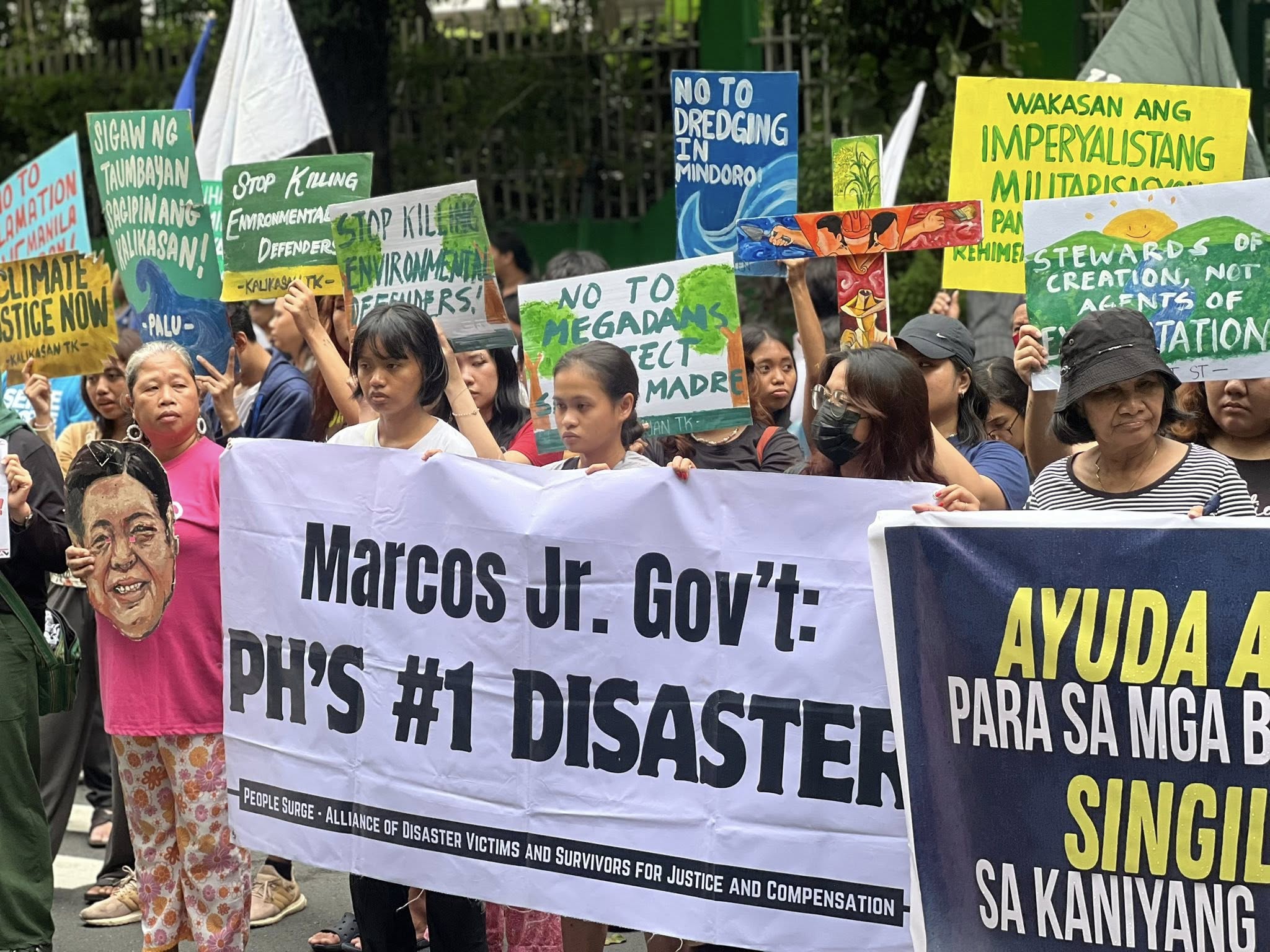
People Surge, a national alliance of disaster survivors, said that many affected communities remain without housing, livelihood, or sustained support.
By Pajo Albano
Bulatlat.com
MANILA – More than 5.2 million people were affected and at least 30 were killed by recent storms, according to data from the Office of Civil Defense (OCD), as survivors and advocates call for a shift from the Marcos administration’s inadequate disaster response to one focused on long-term protection and accountability.
Heavy rains and flooding recently inundated communities across Luzon including Metro Manila, forcing more than 53,000 families into evacuation centers, the OCD reported.
“These are no longer extraordinary events,” Marcos Jr. said during a disaster briefing on July 25. “This is the new normal. This is how life is now, no matter what we do.”
But for survivors and environmental groups, Marcos Jr.’s remarks reflect a dangerous acceptance of crisis, rather than a commitment to addressing it.
Groups cited in a recent LiCAS News report, including Kalikasan People’s Network for the Environment (PNE) and Pambansang Lakas ng Kilusang Mamalakaya ng Pilipinas (Pamalakaya), pointed to reclamation and large-scale infrastructure projects as key contributors to worsening floods and displacement in coastal and rural communities.
People Surge, a national alliance of disaster survivors, said that many affected communities remain without housing, livelihood, or sustained support. The alliance said that the government blamed the poor for systemic failures while neglecting long-term recovery.
Rising costs, mounting demands
Other groups condemned the use of public funds for infrastructure projects found to be superficial or ecologically damaging. For example, Advocates of Science and Technology for the People (AGHAM), a network of scientists and technologists, criticized the Manila Bay Dolomite Beach as a wasteful distraction that does nothing to prevent flooding. The Global Alliance for Incinerator Alternatives (GAIA) raised similar concerns about waste-to-energy incinerators, warning that they worsen pollution, deepen debt, and fail to address the country’s waste crisis.
According to the World Bank’s 2022 Philippine Country Climate and Development Report, the Philippines loses an average of P177 billion $3.2 billion) annually due to climate change impacts, with the poorest communities bearing the brunt. Meanwhile, a policy report by the London School of Economics found that many local disaster offices lack funding, equipment, and trained personnel to prepare for increasingly severe climate events.
As of July 26, the National Disaster Risk Reduction and Management Council (NDRRMC) reported nearly 1,800 active evacuation centers, many of them overcrowded and undersupplied.
Environmental groups urged the Marcos Jr administration to act on a recent advisory opinion issued by the International Court of Justice which reaffirmed states’ legal obligations to address climate change and protect human rights.
Greenpeace Philippines said that the ruling affirms the right to a clean, healthy, and sustainable environment and urged Marcos Jr to support the Climate Accountability Bill and pursue legal action against major polluters. “This ruling opens a new era of climate accountability,” said Virginia Benosa-Llorin, senior campaigner at Greenpeace.
The Center for Energy, Ecology, and Development said that the government should use the opinion to justify phasing out coal and halting gas expansion projects.
Survivors and advocates stressed the need for a complete shift in priorities, away from ecologically destructive ventures and toward community-led recovery, ecological restoration, and systemic reform. They called for investments in nature-based solutions like mangrove reforestation and watershed protection, as well as protection of Indigenous land rights.
“The floods we experience are not just caused by the rain,” Castro said. “They are caused by the decisions of those in power.” (AMU, DAA)
 Save as PDF



0 Comments