
To choose whom to love is everyone’s right
Earlier in June, LGBT students and heterosexual supporters numbering around 500 gathered in the University of the Philippines campus to hold a a Pride parade. Organizers said that they aim to raise awareness about human rights for gay people.
Dubbed “Shameless, Fearless Equality” the event was organized by the LGBT group UPLB Babaylan with militant groups Bayan Muna and Gabriela. The Pride participants carried a gigantic rainbow and demanded justice for murdered LGBTs. The school’s famous symbol, the statue of a nude man standing with outstretched arms, was festooned with giant butterfly-shape wings in the colors of the rainbow to symbolize the flight of gay rights in the campus.
In the meantime, Bayan Muna Representative Teddy Casiño has filed House Bill 1483 defining gender identity and sexual orientation, as well as resolutions calling for investigations into the rise of LGBT killings in the Philippines.
In a speech in the House of Representatives, Casiño said that it was appalling how crimes against LGBTs persist despite the numerous international covenants upholding LGBT rights.
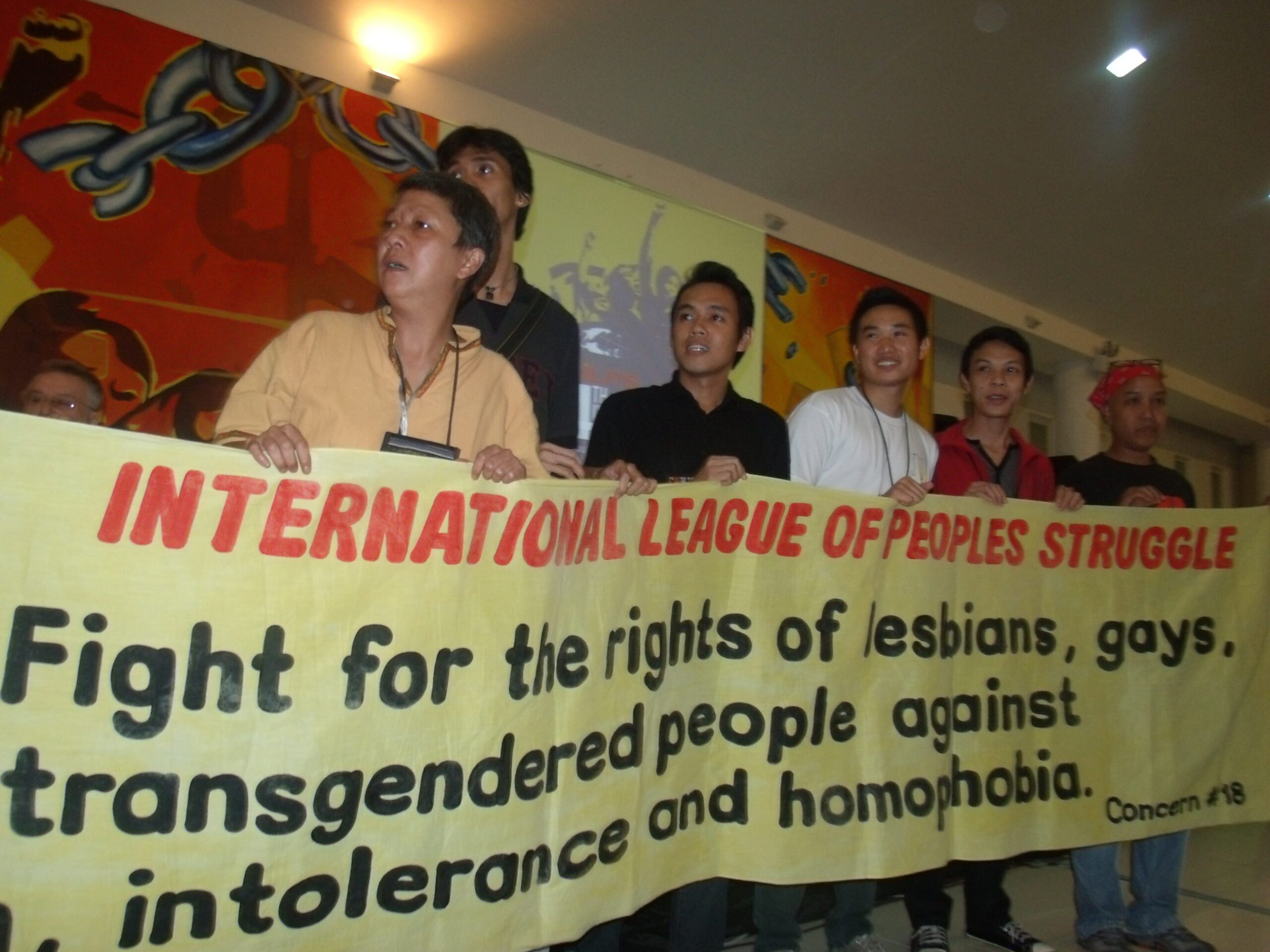
The ILPS recognizes the role of the LGBT community as a potential potent force in the anti-imperialist formations and struggle, and the problem of homophobia is regarded as a peoples’ issue and not just the exclusive domain and burden of the LGBT community.(Photo by Ina Alleco R. Silverio / bulatlat.com)
The United Nation’s International Covenant on Civil and Political Rights, to which the Philippines is a signatory, has perpetually argued that laws criminalizing homosexuality are inherently discriminatory and incompatible with existing international human right standards. UN High Commissioner for Human Rights, Navi Pillay, and UN Secretary-General, Ban Ki-moon have both been calling for the worldwide decriminalization of homosexuality and for further measures to counter discrimination and prejudice directed at LGBTs.
“We are indignant and outraged by reports of the brutalities being inflicted on LGBTs. A gay man was recently sprayed with gasoline and set on fire in Belgium. A transgender human rights defender was murdered in Argentina. A nail bomb explosion in a gay bar in the United Kingdom killed three people and injured dozens of others. A gay rights activist died of multiple knife wounds in Jamaica, prompting a crowd to gather outside his home, laughing and calling out “let’s get them one at a time,” and an execution-style murder killed two lesbian human rights defenders in South Africa. The multiple rape of a lesbian in Zimbabwe was arranged by her own family in an attempt to “cure” her of her homosexuality. Such “corrective rapes” have become prevalent in South Africa whereby the assailant justifies his action by claiming the rape is meant to correct her sexuality and to show the victim is a woman. How can these atrocities continue to happen?”, said Casiño.
Casiño went on to say that in Latin America and the Caribbean, LGBTs are locked up in “psychiatric wards” and “cured” of homosexuality by being tortured physically and psychologically. “Others are subjected to electroshock therapy.”
In the US, anti-gay hate crimes constitute almost 20 percent of all hate crimes. In 2009, 2,181 hate crimes targeting LGBT persons were recorded, and these included 22 murders. One transgender is said to be killed per month.
In 2010, a shocking 250 people were killed in homophobic or transphobic attacks, equivalent to one person killed every day and a half. More than 3,100 homosexuals have been killed in Brazil since 1980.
“The right to choose whom to love is not only for straight men and women. This is a right for all people. No one has the right to impose his or her own views regarding love and sexuality on anyone; and more importantly, no one has a license to abuse, insult or hurt anyone because they’re gay or lesbian. Human rights are for all people, straight or LGBT,” he said.
Casiño filed his proposals on LGBT rights with close consultations with ProGay Philippines. It is a service and advocacy organization that provides counseling, training and education assistance to marginalized gay, lesbian, transgender and bisexual Filipinos, especially the youth and the aging sectors. ProGay initiated Pride traditions in the country when it led the first ever gay and lesbian Pride parade in the entire Asian region on 26 June 1994.
LGBTs for social transformation and liberation
ILPS’ Shauf said that while the League can support civil liberties for marriage equality and rights to serve in an imperialist military, its efforts will be focused on underreported issues of marginalized LGBT communities that need resolution.
“The ILPS recognizes the the role of the LGBT community as a potential potent force in the anti-imperialist formations and struggle, and the problem of homophobia is regarded as a peoples’ issue and not just the exclusive domain and burden of the LGBT community. We share a common vision with other anti-imperialists for a just society, with dignity and respect for all. We affirm that LGBT rights are human rights!,” she said.
The ILPS also advocates for health care, with a focus on HIV treatment and prevention, and transgender-sensitive services for members of the LGBT community. It also stands against job discrimination and exploitation, especially for LGBT migrant workers who experience several forms of discrimination. As it does all this, the ILPS will also advocate for immigrant rights, especially keeping LGBT families together despite immigration and civil status. It will also provide education and resources for LGBT youth to prevent teen suicides, which are reportedly four times higher than average.
“We call on member organizations of the ILPS to set up support groups for LGBT members and advocates within their organizations so as to strengthen the anti-imperialist stand of LGBT individuals and to expand the struggle to end discrimination against women and men with different sexual orientation and gender identity,” Shauf concluded.
In the coming months, the ILPS will organize other LGBT forces and individuals to support the cause of national liberation and anti-imperialist struggle. It will also have a more visible presence in Gay Pride activities as well as other mobilization efforts in ILPS chapters all over the world, and address violence against LGBT people, including state-sponsored executions and hate crimes. 
 Save as PDF



This is in reference to my former comments saying that the “mentioned Pride march” attended by 500 participants “happened in July 6 at UP Los Banos,” and that it was “a joint activity of PROGAY and UPLB Babaylan…”
Here’s another good news: During the march, KPL-Southern Tagalog, PROGAY-Southern Tagalog, and other marchers got a commitment from a Laguna provincial board member to sponsor provincial resolutions for the youth and LGBT’s. Said organizations are now conducting consultations and workshops to formulate draft resolutions to be passed to the provincial board.
Said Pride march was a joint activity of PROGAY and UPLB Babaylan (a pioneer organization of today’s PROGAY Southern Tagalog regional Network).
The mentioned Pride march happened in July 6 at UP Los Banos.