
In Wish-Swapping, what does the red balloon that the naked child is holding signify? Or what does the exchange of glances mean? Is it just the boy’s jealousy for the girl who the father is carrying on his shoulders or could it mean something else?
For this author, it seems that the child, holding the red balloon is asking the father about the mysteries of life and the look that registered on the man’s face is a sign of amazement.
The author can’t help but remember, upon seeing that painting the amazement of the rabbis and the elders of the Temple of Jerusalem over the child Jesus who was only 12 years old when he engaged them in a debate over the Scriptures.
In the Reed Thin Bathers, is it just the sea the two young lovers (as the author assumes they are) are staring at? OrReed-Thin are they wondering what will happen to them in the near future when they decide to tie the knot?
The baby looking at another baby who happens to be asleep (Curious Gaze) seems to be expressing the amusement of seeing oneself in a mirror, only that their looks aren’t exactly the same.
Learning to be human by reflecting on the acts of another human

As you look at each picture that Camille has painted and carefully detailed, you can see that you are reflecting on your own emotions and that you are actually drawn into the realization that being human is not only having a human face, a human body, a human mind but a human heart—just what like happened to this author.
Each time that I reflect on the colors and hues, the lightness and darkness of each character of Camille’s works, which are hanging on the wall, counter-staring at me, I am learning…and little by little, I am beginning to understand that humanness depends of understanding the “I” or the self and that, to be able to learn about the self is to learn it from examining others but without duplicating or attempting to be another person or self.
Am I the “Outcast?” or I am not?
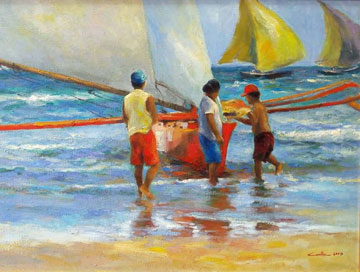
Am I “Preparing to Sail” to the farthest and the deepest part of the sea—which in psychology refers to the depths of the human mind, particularly the unconscious that is much discussed in the works of Sigmund Freud and Carl Jung—which is the consummation of the wholeness of my being as a human and a part of the ever-changing society that the tides in Camille’s seas in canvass want to depict? Or am I not?
Other notes
It is appreciation of the genius of Camille de la Rosa that I have drawn from the above observations
The development of Camille is triggered, the author presupposes, both by external and internal factors: (1) the painter’s innate desire to be a master of her craft; (2) her exposure to the works of the masters, especially during her tours in Paris and in Malaysia, perhaps; and (3) she had been blessed with such an enormous talent and that talent continues to develop as she experiments in color, hues and texture.
And all of these have been proven true by her latest exhibit.
On the other hand, we are expecting more of Camille in the coming days. Watch out as the master-in-the-making sails her boat to the seas of the surreal. (Bulatlat.com)
 Save as PDF







0 Comments