
De Ocampo said, “In the Philippines, rap music, which has a progressive origin, appeals mostly to youths belonging to the marginalized sectors since it can be played even without musical instruments that they cannot possibly afford.”
BAYAN USA performed an oratorical piece written by Armando Vencero entitled “SONA ng Panlilinlang: Ramdam ang Kahirapan” (SONA of Deception: Poverty is Felt). The piece ended with the lines: Ramdam ang kahirapan at hindi ang kaunlaran!/Ramdam ang pagnanasang rehimen mo ay wakasan!” (What is felt is poverty, not progress! The urge to end your regime is felt!).
All throughout the program, Musicians for Peace provided the ‘bridge music’ (music which fills the gap between the parts of the program) using percussion instruments. The group also used ‘found objects’ such as a water jug aside from the traditional percussion instruments.
Portrait of the Filipino family
The UP Repertory Company (UP Rep), meanwhile, staged a “tula-dula” titled “Ang Kasalukuyang Mukha ng Pamilyang Pilipino”. It deals with the daily predicaments of a Filipino family.
The father, Nante Poorita, worked in a factory for a very low salary and was eventually dismissed. His wife Nancy is a public school teacher who tries to cope amid the crisis of Philippine education. Their daughter Iska is trying to survive in a state university, which is becoming more elitist.
UP Rep’s Mimi Aringo explained that “the story of Poorita family is the story of countless Filipino families. Workers, government employees such as teachers and students are all oppressed and exploited in a systematic way.”
Visual exigency
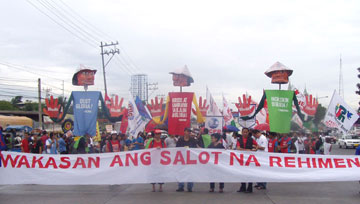
Higante effigy representing three marginilized sectors in the Philippines (Photo by Jeffrey Ocampo)
Red emerged as the dominant color of the event. The sky was painted red as flags of different organizations were waved. Similarly, the stage’s backdrop was a red tarpaulin containing the phrase ‘People’s SONA’ with an image of clenched fists printed below it. Red has been historically used to symbolize radicalism and opposition to the prevailing system.
The Promotion of Church People’s Response (PCPR) made higantes (large images) representing three marginalized sectors in Philippine society — workers, peasants and the middle class.
Roel Anda of PCPR said it took them a week to finish the higantes. The faces of the higantes were made out of papier-mâché and bamboos were used for their frames. The PCPR said the higantes represent the people’s “higanteng protesta” (giant protest) against the Arroyo administration. This, according to PCPR, is one way by which church people support the struggles of these sectors.
Members of Salinlahi Alliance for Children Concerns also presented their own version of higantes. They made faces out of cardboards and water-based paints. They also used torn clothes to symbolize the impoverished condition of the people. Franstel Garcia of Salinlahi said they used their “kalawakan ng imahinasyon” (the vastness of imagination) to come up with and execute these ideas.
Another effigy, made by Bayan Muna Partylist, portrayed the president as a bat. Bamboo and black taffeta cloth were used. The effigy portrayed the president as a blood-sucking creature feeding on the misery of the people through the value added tax (VAT) on petroleum products. The logos of oil companies such as Petron, Chevron and Shell were used as pendants adorning the bat. The earrings, on the other hand, were shaped as dollar signs.
 Save as PDF

I love your wordpress theme, where would you get a hold of it through?