
The recently held human rights summit took the first agonizing step towards finding solutions to the epidemic of extra-judicial killings and enforced disappearances. The solutions proposed will pit those in the judiciary against the forces of resistance in the executive branch and Congress.
BY THE CENTER FOR PEOPLE EMPOWERMENT IN GOVERNANCE (CenPEG)
Contributed to Bulatlat
HUMAN RIGHTS WATCH
Vol. VII, No. 24, July 22-28, 2007
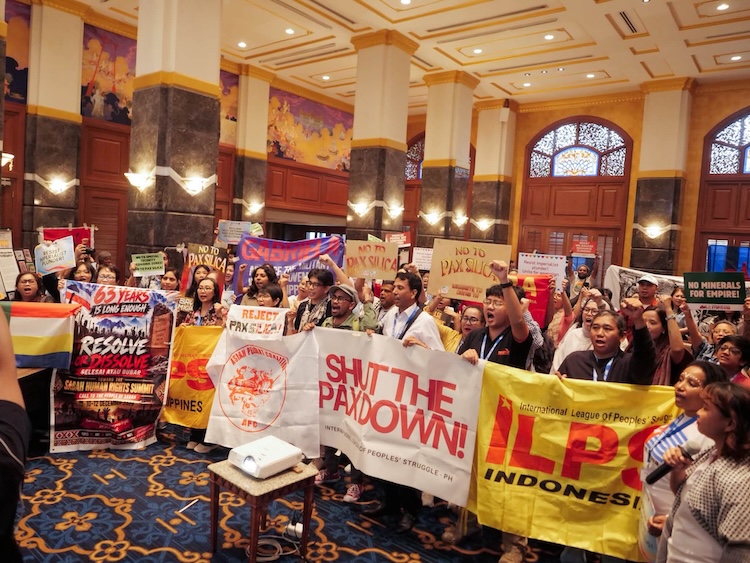
The human rights summit held last July 16 and 17 at the Manila Hotel brought together about 250 participants in search of solutions to the epidemic of summary executions and enforced disappearance that has hounded the nation since 2001.
Responding to the invitation of Supreme Court (SC) Chief Justice Reynato Puno, the participants included lawyers, academic scholars, human rights volunteers, legislators, interfaith leaders and press freedom advocates, as well as government executives and magistrates. Conspicuous in their uniform were elements of the military and police led by their officials. The presence of some members of the diplomatic corps including a representative of the International Criminal Tribunal for the former Yugoslavia (ICTY) underscored the fact that this particular domestic concern has achieved an international dimension, as is the case of other countries like Rwanda where there is rampant human rights violations.
The summit was convened to address the deteriorating state of human rights in the country. Ironically, human rights groups, cause-oriented organizations and interfaith groups – whose members were also victims of extra-judicial killings and enforced disappearances – had to lobby hard on the eve of the event for them to be invited to participate.
Just the same, the summit was said to be “unprecedented” for having been initiated by the high court chief justice to address the pressing issue of political killings, with about 865 victims to date aside from hundreds of other victims of frustrated murder and enforced disappearance committed allegedly by state security forces under the watch of President Gloria M. Arroyo.
In his keynote address, Puno said that the judiciary decided “to unsheathe its unused power to enact rules to protect the constitutional rights of our people, the first and foremost of which is the right to life itself.” Described as a “risk taker,” Puno has sought to marshal “judicial activism” to confront attacks on the rule of law the arrest of which, in his opinion, has failed to draw any action from the legislative and executive branches of government.
Unprecedented
In that light, the summit was indeed unprecedented. But the atrocities, where most victims were unarmed civilians collectively in their tens of thousands, have persisted – fueled no less by a culture of impunity and fear – since the Marcos dictatorship started in 1972. The high court itself had been strongly criticized for its complicit stance during martial law and also for rulings it issued after that, particularly on the issues of warrantless arrest and military checkpoints that showed tendencies toward authoritarianism.
Under Macapagal-Arroyo, the failure of the country’s criminal justice system to protect victims of crimes against humanity forced their families and human rights groups to ask the international community for support. Thus it took nearly 900 extrajudicial killings and 50 murdered journalists, as well as pressures from the international community, for the Supreme Court to realize that the atrocities are not only attacks against constitutional, civil and political rights but a subversion of the rule of law.
By then, however, the victims and their kin have already lost hope in the justice system precisely because the system – specifically many of its investigators and adjudicators – had been prejudicial to them. Graver injustice was being committed due to the system’s failure to uphold the victims’ rights. Among many prosecutors and judges, there appears to be poor competence in the field of human rights and humanitarian law, let alone a compassion for the targets of political persecution. The SC justices, benumbed by their so-called “cold neutrality,” should be the first to know: The court system is not for the poor and defenseless. The sword of justice that is now unsheathed has not only been unused – it has long been corroded by the apathy of the judiciary itself.
 Save as PDF


0 Comments