
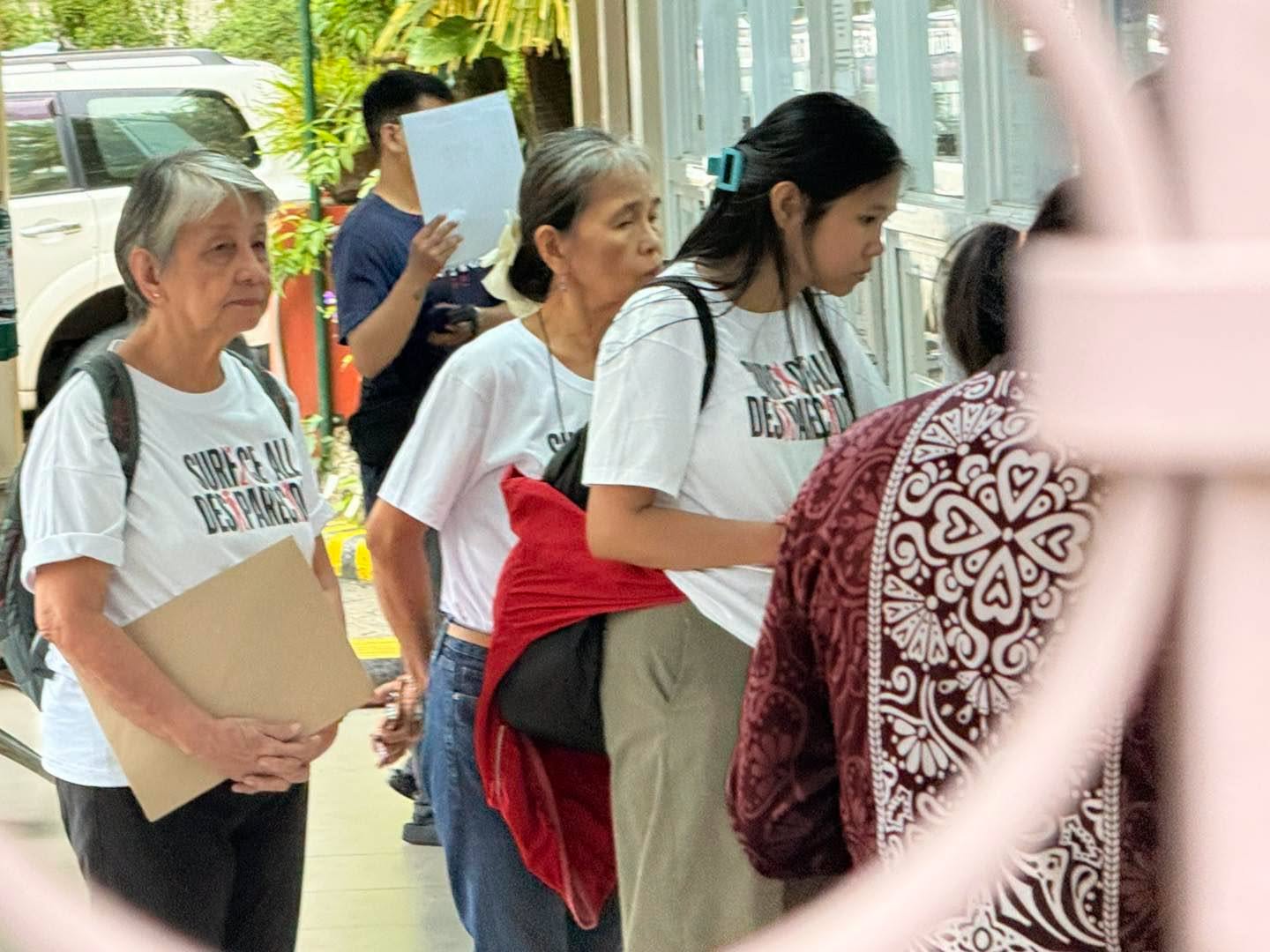
“Not a single success story, not one was recovered even with orders from the court.”
MANILA — Left with no choice but to push back, families of enforced disappearance victims called on the Supreme Court to review the writs of amparo and habeas data for “persistent ineffectiveness” for nearly two decades.
“Not a single success story, not one was recovered even with orders from the court,” Edith Burgos, mother of disappeared activist Jonas Burgos, told Bulatlat in an interview. She is the president of International Coalition Against Enforced Disappearance (ICAED) and vice chairperson of human rights group Karapatan.
Read: Bulatlat’s special archives on Jonas Burgos
The writ of amparo, which took effect in 2007, is supposed to protect an individual’s rights to life, liberty, and security against unlawful threats or violations. The writ of habeas data which took effect in 2008 is supposed to provide a remedy against unlawful gathering, collection, or storage of personal information and protects a person’s right to privacy.
“We wrote to the Chief Justice because there have been no positive results. We listed all the cases here and it is high time for the Supreme Court to review their own administrative order for the writs,” Cora Jazmines, wife of disappeared labor activist James Jazmines and one of the signatories of the letter sent to the SC, said in Filipino.
Read: A year after husband’s disappearance, Corazon finds more questions than answers
Since the writs took effect, human rights group Karapatan and Desaparecidos documented 272 cases of enforced disappearance: 206 cases in the administration of Gloria Macapagal-Arroyo, 29 cases during Benigno Aquino III, 20 cases during Rodrigo Duterte’s administration, and Ferdinand Marcos Jr. has 17 cases as of this writing.
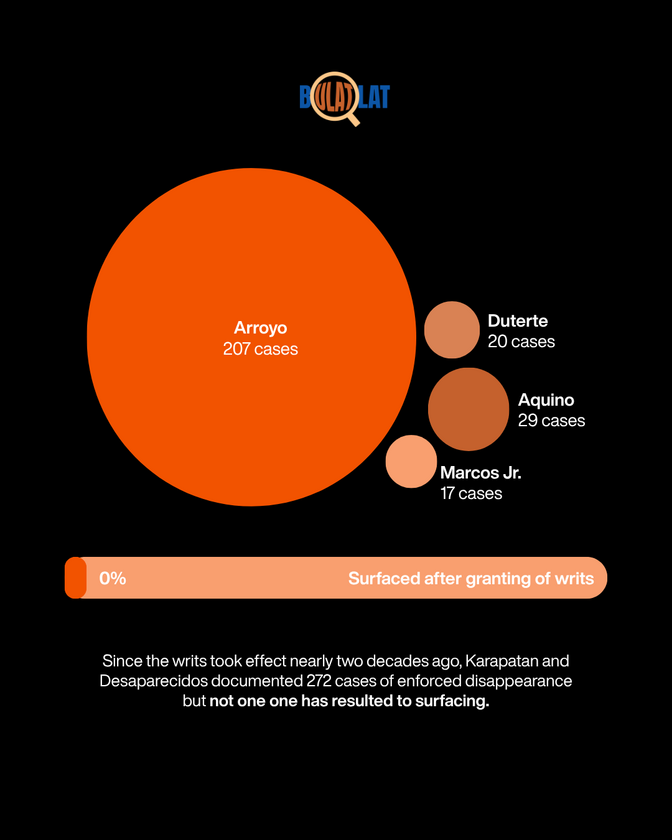
Prior to Arroyo’s administration, there were at least 2,000 unresolved cases of enforced disappearances.
“Rather than ensuring immediate protection and accountability, many petitions have been met with procedural delays, dismissals, or orders that are inadequately enforced. The persistence of disappearances across successive administrations—and the continued rise in cases even after the writ’s promulgation— exposes systemic failures in the implementation and enforcement of human rights protections,” Desaparecidos, a group of families and friends of victims, said in their letter.
Below are the following cases that the groups cited:
- Karen Empeño, Sherlyn Cadapan, and Manuel Merino (Disappeared June 26, 2006, Hagonoy, Bulacan): The writ of amparo was filed on October 24, 2007, with the Supreme Court issuing the writ on October 25, 2007. Despite the Court of Appeals ordering their immediate release on September 17, 2008, the victims remain missing.
- Romulas Robiños (Disappeared November 17, 2006, City of San Fernando, Pampanga): The Supreme Court issued a writ of amparo on November 8, 2007, but the Court of Appeals later dismissed the petition citing “lack of evidence.” He remains missing.
- Nilo Arado and Maria Luisa Posa-Dominado (Disappeared April 12, 2007, Oton, Iloilo): A writ of amparo was granted by the Iloilo Regional Trial Court on December 17, 2007, ordering their release. They remain missing.
- Jonas Burgos (Disappeared April 28, 2007, Quezon City): The writ of amparo was issued by the Supreme Court on December 24, 2007. The Court of Appeals partially granted the writ on July 17, 2008, ordering investigations. He remains missing.
- James Balao (Disappeared September 17, 2008, La Trinidad, Benguet): The writ of amparo was partly issued on October 9, 2008, but later reversed on January 19, 2009. He remains missing.
- Elizabeth “Loi” Magbanua (Disappeared May 3, 2022, Valenzuela City, Metro Manila): The Supreme Court issued the writ of amparo on August 23, 2022, and the Court of Appeals held the military accountable on September 9, 2022. Magbanua remains missing.
- Maria Elena Pampoza and Elgene Mungcal (Disappeared July 3, 2022, Moncada, Tarlac): The writ of amparo was granted by the Supreme Court on November 29, 2022. They remain missing.
- William Lariosa (Disappeared April 10, 2024, Quezon, Bukidnon): After dismissal of habeas corpus and amparo petitions, the Supreme Court ruled in favor of the family in August 2026 and directed military respondents to respond. He remains missing.
- Dexter Capuyan and Gene Roz Jamil de Jesus: Petitions were filed in August 2024 for writs of amparo and habeas data. On August 12, 2025, the Court of Appeals declared the Capuyan and de Jesus as victims of enforced disappearance, contrary to the outcome of the police investigation which concluded that the two were merely in hiding. The CA granted the writ of amparo.They remain missing.
- James Jazmines (Disappeared August 23, 2024, Tabaco City, Albay): The writ of amparo was issued on May 6, 2025, with the Court of Appeals granting the writ on January 14, 2026. He remains missing.
- Felix Salaveria, Jr. (Disappeared August 28, 2024, Tabaco City, Albay): The writ of amparo was issued on February 5, 2025, and the Court of Appeals granted the writ on July 21, 2025. He remains missing.
There are several patterns that Burgos identified: the process is long when it’s supposed to be a “swift” remedy, the state forces are uncooperative; no thorough investigation despite orders from the court; and, no one is cited in contempt for not following.
“In my experience in the search mission, they won’t let us in. If they would, only to their receiving office but not to allow us to search thoroughly in their camps or detention facilities,” said Burgos. “Even with the writs granted and even when the Commission on Human Rights (CHR) goes with us, it’s the same.”
Read: In the Philippines, women brave the frontlines to find the disappeared
The CHR conducted at least 60 investigations related to enforced disappearances under the current administration, according to the data sent to Bulatlat.
Burgos added that state forces have been hostile to the families and human rights defenders conducting the search. “They were not only condescending but they were also angry. It was intimidating for us and there were times that we had to step back,” she said.
What is more alarming is that the families searching for their loved ones are also being harassed, Burgos said. It comes in the forms of red-tagging and surveillance.
In some cases, survivors of abduction have been denied protection of the writs of amparo and habeas data, such as the case of environmental activist Eco Dangla.
Dangla was abducted on March 24, 2024 by armed men, but after strong push back from environmental and international groups, he was surfaced four days later together with his fellow environmental activist Joxelle Tiong.
“This climate of impunity not only denies justice to the disappeared and their families but also places those who seek truth and accountability at continuing risk,” the letter noted.
The families recommended the strengthening or preventive and protective functions of the writs, ensure timely and effective judicial responses, expand the scope of protection to include groups and associations vulnerable to red-tagging, mandate the issuance of temporary protection orders, and improve the transparency and accountability mechanisms for independent investigation to prosper.
Desaparecidos also called on the Philippine government to ratify the International Convention for the Protection of All Persons from Enforced Disappearance. It is the only core international human rights treaty that the Philippines has not yet ratified. There are at least six UN treaty bodies that recommended its ratification too.
The Philippine government previously denied the need for such ratification because of the enactment of the Anti-Enforced Disappearance Law in 2012. However, there has been no conviction yet under the law and no budget has been allocated for its implementation.
Read: 13 years on, still no budget for CHR to implement anti-enforced disappearance law
If the Philippine government ratifies the convention, it will be obliged to also report on the Committee of Enforced Disappearances (CED), a body composed of experts elected by state parties. The committee wields significant authority: it can scrutinize state-submitted reports, carry out country visits to assess compliance, and even launch independent investigations into alleged violations.
Read: The long-overdue ratification of UN convention on enforced disappearance in PH
In her capacity as ICAED President, Burgos said that all the documented cases were all submitted to the United Nations (UN) and various international human rights organizations.
“Asia has the highest submitted documents because of the thorough investigation and documentation efforts led by Karapatan,” said Burgos. “It’s not that we have more victims, it’s just that we report more with these paper trails.”
The submission of the letter comes as victims’ families and human rights organizations mark the International Day of the Disappeared on August 30.
“For families of the disappeared, every delay prolongs their anguish and allows impunity to persist. We are aghast that many more become victims of abduction and enforced disappearance, after loved ones have disappeared,” Burgos said. “We will continue to demand justice, and realize justice wherever we may find it.” (RVO)
 Save as PDF


0 Comments