
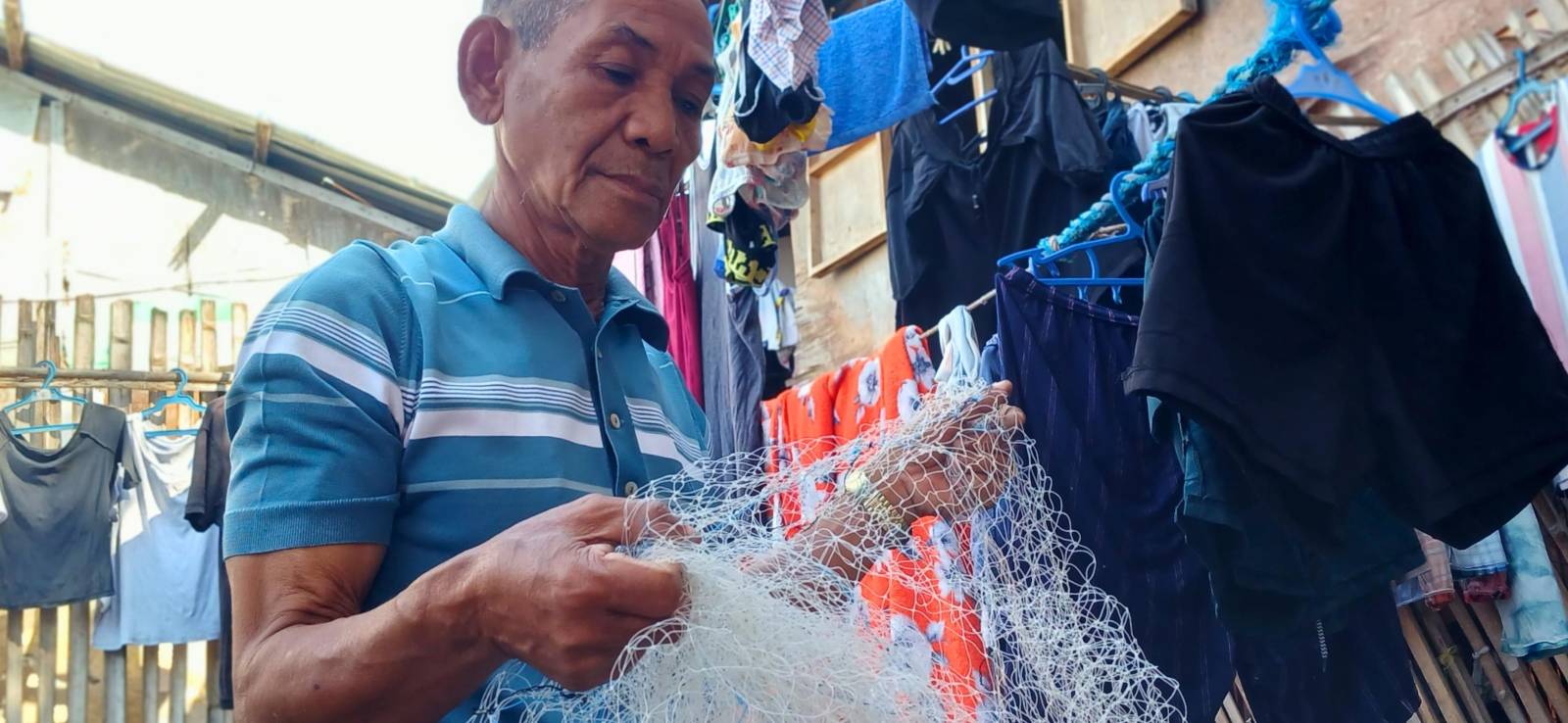
GENERAL SANTOS — In Barangay Buayan, General Santos (GenSan) City, Elias and Virginia Navidad have spent decades fishing side by side.
“If Elias fished with another person, he had to split the catch,” Virginia said in a December 2023 interview with Bulatlat.
What began as a practical approach became the foundation of their family’s livelihood. Fishing together meant keeping every peso they earned, enough to send all of their children through high school, their youngest through college, and gradually buy the gear they needed to stay at sea.
Buayan is on the northern edge of Saranggani Bay, a rich fishing ground that has long sustained families like the Navidads and is now a vital conservation site.
The Saranggani Bay Protected Seascape covers the whole Sarangani Bay, with General Santos City bordering the northern coast, Sarangani towns on the west and east sides, and the Celebes Sea to the south.
When the couple moved there in the early 1980s, they owned neither a boat nor a net. They joined neighbors on fishing trips, saving spare cash until they could buy their first net. A relative later gave them a paddle boat, and informal loans eventually helped them buy a pumpboat engine.
However, Virginia said that the sea no longer provided as it once had. “You’re lucky to earn P1,000 (USD 16.28) from an overnight trip. Before, we could make P4,000 (USD 65.04).”
Elias blamed the nearby coal plant’s pollution of shrimp ponds, stressing that fish and shrimp that once filled their nets within hours had become scarce. Tamban (sardine) and tulay (bigeye scad), once common catches, had nearly disappeared, forcing their neighbors to sell their boats at lower prices.
Even with a mangrove nursery nearby, Elias said that it may not be enough to counter antibiotics and oil spills.
The couple turned 60 in 2025 but, at the time of interview, they cannot afford to retire. “It’s hard,” Virginia said, lamenting how they were now forced to go farther out to sea.
Elias has lived with only one arm since childhood. Whenever Virginia cannot join him, one of their daughters would. He also worked part-time as a tricycle driver to make ends meet but he always returned to fishing.
After dinner on the evening of the interview, the couple prepared once again to head to the sea, cast their nets through the night, and sell what they caught at dawn. They will repeat the cycle the next day.
Years earlier, they returned from fishing to children watched over by their neighbors or to an empty house while the kids were at school. Now, they come home to an extended family and to a daughter who has passed the licensure exam for public school teachers.
The imam and their community in Labangal
Like the Navidads, Musa Halipa built a new life in GenSan. He and his family fled the conflict in Jolo and settled as informal residents in barangay Labangal.
There they joined displaced families from Sulu, Tawi-Tawi, and Zamboanga, alongside Maranao, Maguindanao, Tausug, Christian, T’boli and Glaan communities.
Life in Jolo had offered richer fishing grounds, imam Halipa recalled, but constant gunfire pushed them to leave. In GenSan, they encountered a different kind of danger.
“Marami na napatay dito dahil pinabaril,” said Salome Macalihis, referring to killings that residents associate with private fishing compounds used by tuna companies.
According to Macalihis, one victim was later recovered by the coast guard, adding that a child survived a shooting but was left bedridden while the child’s father was killed.
These private compounds can have enclosed docking and storage areas with heavy security. Former purok officer Jacob Araham said there were warnings. “Fishers can pass by, but if you stay there to fish, you’ll surely be shot.”
A fisher who requested anonymity estimated that a private compound spans about 200 meters, roughly the length of seven basketball courts.
If not gunfire, jail
A municipal ordinance in Glan in Sarangani barred fishers from General Santos from fishing, even if they carried permits.
The same fisher said that he had been jailed several times, including one detention that lasted 10 days since bail depends on whether boat owners can afford the P10,000 required for each crew member. At times, fellow fishers in their barangay pooled money to cover the cost.
Araham said that the policy disproportionately affected small-scale fishers, as penalties escalate with confiscation of catches, boat and fishnet. “How can we survive if we’re always arrested? Without the sea, our only source of livelihood, we’ll be forced to commit crimes. What will happen to our families?”
The ordinance was meant to protect Glan’s marginal fishers and ensure municipal waters benefit local communities. But Halipa said that capitalists gained the upper hand by putting up fish corrals near shore, financing offshore payaos (fish aggregating device), and expanding commercial fleets. According to him and other fishers, these led to limited fishing grounds and leaner catches, pushing several fishers into crime.
Fishworkers Solidarity, a federation representing tuna workers, fishers, aquaculture laborers and fish vendors, later negotiated with local governments. In an update, the federation said that the compound shootings ceased in 2024 because the fishers no longer go to those areas. In 2025, the group reached an agreement allowing its members to resume fishing in Saranggani.
The group said that the ordinance must be repealed since their agreement is only with a GenSan councilor and an allied Sarangani representative and it lasts only while they remain in office.
For Halipa, the formation of the Labangal Kulasi Small Fisherfolks Association with support from Fishworkers Solidarity was instrumental in these changes. The federation now has 817 members in General Santos and 397 in Sarangani.
“They trained us, held seminars, and connected us with lawyers. It’s difficult to get attention when you’re alone,” he said. (DAA)
 Save as PDF



0 Comments