
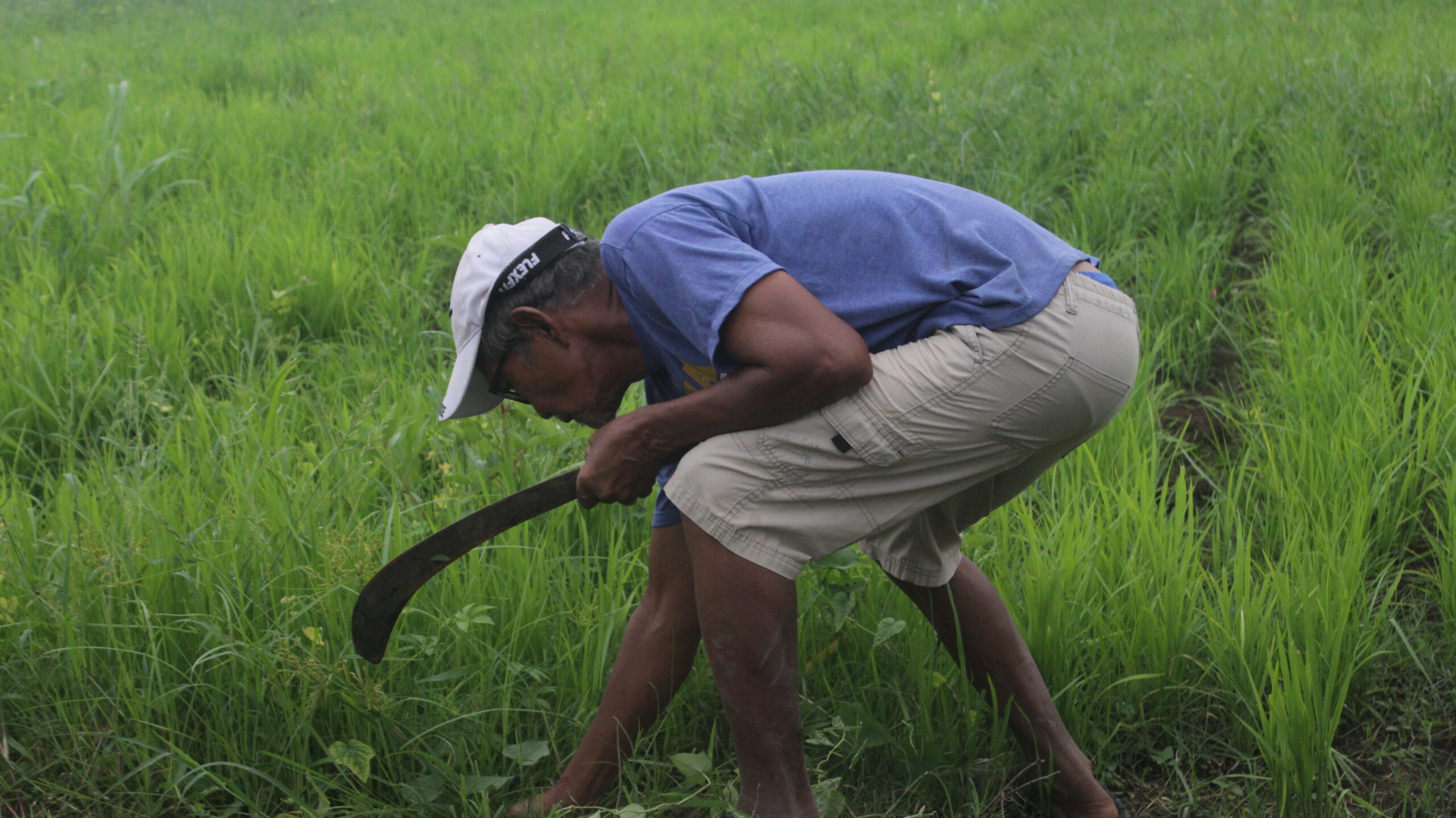
BULACAN – As inflation dropped to 1.8% (the lowest in nearly five years) in March, rice farmers are experiencing a reduction in palay (unhusked rice) prices.
“Low inflation means nothing if food prices remain sky-high and wages are still insufficient,” said Cathy Estavillo of Amihan National Federation of Peasant Women and second nominee of the Gabriela Women’s Partylist. “The true measure of progress is not just low inflation, but the ability of every Filipino family to afford enough food, decent shelter, and a livable income. And right now, these are lacking under the Marcos Jr. administration.”
Estavillo, together with Makabayan senatorial candidate and leader of Kilusang Magbubukid ng Pilipinas (KMP) Danilo Ramos, criticized the Department of Agriculture (DA) and the National Food Authority (NFA) for the “blatant neglect and abandonment of rice farmers.”
They condemned the NFA’s failure to procure palay at a fair and decent price, leaving small farmers vulnerable to exploitation by abusive traders and powerful rice cartels. They also slammed the DA’s continued dependence on rice importation which they said lowers local prices and further burdens Filipino farmers.
“Because of the extremely low price of palay, farmers are constantly being shortchanged. In Nueva Ecija and Isabela, the buying price of palay is only around P14 to P16 per kilo. In other areas, it’s even lower,” said Ramos. “The Department of Agriculture and the NFA are not taking any concrete action. Where is the support they claim to provide for farmers?”
Estavillo echoed these concerns, noting that the NFA has not yet announced rice procurement. She said that government press releases are not enough while farmers continue to suffer from hunger and poverty. She added that women farmers are bearing the heaviest burden as palay prices remain low while production costs keep rising.
The groups also criticized the DA’s recent statement that it is “studying” a floor price or minimum price of P17 to P23 per kilo for palay. “If the floor price is set at P17, this is not real help. In fact, it would only legitimize the undervaluation of our produce,” Ramos said. “P17 is no longer enough, especially since the production cost for farmers is already between P18 to P21 per kilo. The floor price should be fair and should ensure a decent livelihood for farmers—not just serve as a token gesture to make it look like the DA has acted.”
Estavillo said that a vague promise of a possible floor price is not a substitute for actual, immediate intervention. “Farmers need direct procurement now at a just price. Anything less is tokenism,” she said. Farmer groups are demanding that the NFA immediately begin procuring palay at no less than P23 per kilo as a support price; that the DA impose limits on rice importation, especially during the local harvest season; and that the government increase subsidies for production inputs such as fertilizer, fuel, and seeds.
They also reiterated the call to shift the country’s rice policy away from import dependence and toward food self-sufficiency. Estavillo said that the solution lies in strengthening local production and defending the livelihood and dignity of Filipino farmers.
To support these urgent demands, Ramos and Estavillo expressed support for the proposed Rice Industry Development Act (RIDA) authored by the Gabriela Women’s Partylist and the Makabayan bloc at the House of Representatives. The bill aims to revitalize the Philippine rice industry through comprehensive support programs and infrastructure development. It allocates P25 billion (450 million USD) for subsidies to rice production and socialized credit, P45 billion (810 million USD) for irrigation development, P20 billion (360 million USD) for irrigation systems repair and rehabilitation, P30 billion (540 million USD) for post-harvest facilities development, P50 billion (900 million USD) for farm inputs, and P15 billion (270 million USD) for research and development of sustainable agricultural technologies.
The bill also seeks to institutionalize essential production support programs and services for rice farmers; complete infrastructure and facility requirements for rice industry development; establish a legal and policy environment that protects rice farmers; increase farmers’ income through transitional government support measures; and strengthen the rice distribution system by building closer linkages between rice farmers and consumers.
“RIDA is a concrete step toward genuine reform in the country’s rice industry. We support it because it offers a comprehensive solution to the problems faced by farmers,” Ramos said.
Estavillo said, “Through RIDA, the dignity of farmers can be restored and the country’s food security can be ensured.”
Meanwhile, despite the decline in the inflation rate, prices of basic food items have sharply increased in March. Garlic is at P335 (6.03 USD) per kilo, red onions at P130 (2.34 USD), eggplant at P108, and pechay at P90 (1.62 USD). Pork (liempo) has surged to P422 (7.60 USD) per kilo, chicken to P204 (3.67 USD), and fish like galunggong has skyrocketed to P317 (5.71 USD) per kilo. These rising prices are pushing Filipino families deeper into financial strain.
The decrease in inflation does not mean a decrease in the prices of all goods. Many essential expenses like rent, services, and several food items remain high, continuing to burden ordinary Filipinos. Inflation data from the Philippine Statistics Authority (PSA) shows the overall price level of food has increased by 16% between June 2022 and February 2025. The recent survey by the Social Weather Stations also shows Filipinos experiencing involuntary hunger more than doubled since the beginning of Ferdinand Marcos Jr. administration – from 11.6% or some 2.9 million families in June 2022 to 27.2% or 7.5 million families in March 2025. (AMU, DAA)
Author’s note: $1 is equivalent to P56.98, this means that the floor price of palay is way lower than $1.
 Save as PDF




0 Comments