
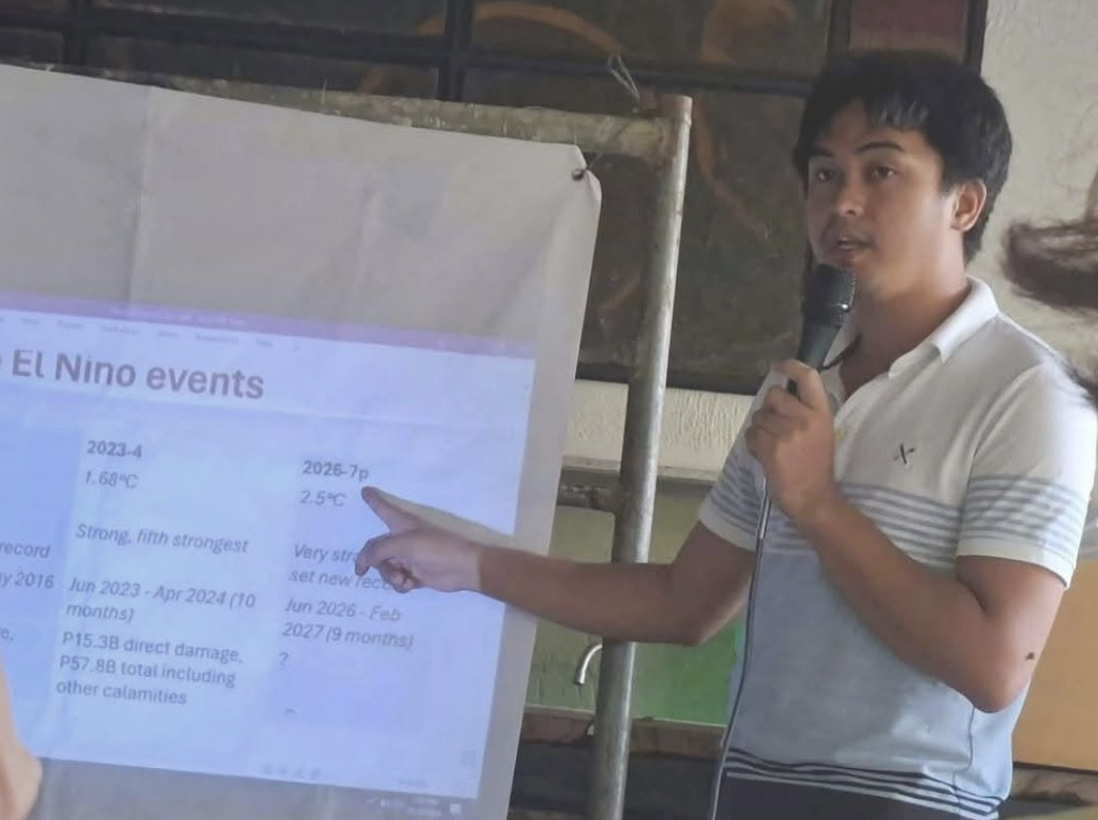
Repeated surveillance restricted his movements and caused anxiety over his family’s safety.
When he was a university student, he questioned the purpose of agricultural education. Now he is organizing landless farmers and fisherfolk.
Jesus Monasterial has spent more than two years working with rural communities in Southern Tagalog. However, his work resulted in repeated surveillance by state forces, peasant groups said.
On October 31, Tanggol Magsasaka–Timog Katagalugan reported that a police intelligence operative identified as “Bruno” had been asking about Monasterial’s whereabouts in Lian, Batangas. The operative was reportedly previously assigned in Nasugbu.
At the time, Monasterial was assisting a protest camp in Barangay San Diego, where farmers, fisherfolk, and residents opposed the possible demolition of several houses.
“I was on my way back to the people’s protest camp in San Diego when news reached us that someone had been asking about my personal information,” he said.
The camp was established by Samahang Mangangawil 1979 and the San Diego Homeowners’ Association, with support from the Katipunan ng mga Samahang Magbubukid sa Timog Katagalugan (KASAMA-TK) and Pambansang Lakas ng Kilusang Mamamalakaya ng Pilipinas–Timog Katagalugan (PAMALAKAYA-TK).
The incident prompted fellow organizers to discuss security measures. They also plan to file a complaint before the Commission on Human Rights (CHR).
From student to organizer
Monasterial’s involvement in peasant organizing began at the University of the Philippines Los Baños (UPLB) where he was enrolled in BS Agricultural Biotechnology.
Coming from a family of farmers in Bicol, where his grandparents worked as agricultural tenants, he became increasingly critical of an agricultural education system that he said served the interests of transnational corporations rather than addressing farmers’ lack of land and government support.
Through the League of Filipino Students–UPLB, he became involved in social issues action and joined community immersions with farmers in Tartaria, Silang, Cavite, as well as Mangyan communities in Mindoro and Dumagat communities in Rizal.
These experiences led him to leave his studies and become a full-time organizer. He now serves as deputy secretary-general of KASAMA-TK.
His work involves staying in communities, conducting consultations and political education, and helping establish local farmers and fisherfolk associations.
“Being a full-time organizer means devoting my entire time to the communities and being far from my loved ones,” he said, adding that he had to set aside his plan to finish college.
Surveillance
The October 31 incident was not the first reported surveillance involving Monasterial.
On July 19, 2026, soldiers from the 16th Infantry Battalion of the Philippine Army reportedly sought to identify the organizers of KASAMA-TK’s Regional Peasant Consultation in Barangay Malinis, Lemery, Batangas.
On September 21, a man introducing himself as “Del” Dela Cruz reportedly approached a member of Sugarfolks’ Unity for Genuine Agricultural Reform (SUGAR-Batangas), attempting to persuade the member to leave the organization and provide information about its activities.
According to Tanggol Magsasaka–Timog Katagalugan, the man showed footage of a protest outside the Department of Agriculture regional office led by the Alyansa ng Magsasaka para sa Kumpensasyon (AMK), SUGAR-Batangas, KAISAHAN, and KASAMA-TK. He allegedly warned the member against working with Monasterial, claiming that the organizer was “already drawing attention.”
The protest resulted in a dialogue with government representatives to demand agricultural inputs and implements for farmers and farmworkers affected by successive calamities.
The groups also cited previous incidents in Barangay Casile, Laguna; Lupang Ramos and Tartaria, Cavite; and Coron, Palawan.
Monasterial said that the repeated surveillance restricted his movements and caused anxiety over his family’s safety. “Repeated surveillance limits my movements as an organizer and makes me fear returning home to my family because they might also be targeted by the state due to my advocacy.”
Persisting
Despite the threats, Monasterial said that his work remains rooted in the struggles of farmers and farmworkers.
In Batangas, he witnessed sugarcane cutters and loaders receiving only P350 to P400 for every ton of cane harvested and loaded onto trucks. Their wages are paid at the end of harvesting seasons that can last six months, forcing many to rely on loans and advances.
Through community discussions, he helps workers understand their rights to organize unions and demand decent wages, humane working conditions, and genuine land reform.
“I continue organizing despite the threats and dangers because I know that what I am doing is not wrong and is necessary,” he said.
Addressing allegations that he was recruiting farmers, Monasterial acknowledged encouraging them to establish their own organizations. “I am indeed encouraging them to establish their own farmers and fisherfolk associations.”
“People naturally resist a society where farmers have no land, yet land is reserved for foreigners, and those who produce the country’s food have nothing to eat,” he said.
Citing figures from their organization, Monasterial said that 56 of the 72 political prisoners in Southern Tagalog come from farming and indigenous communities or are their advocates.
Tanggol Magsasaka–Timog Katagalugan called on allied organizations to condemn the surveillance and urged the CHR and the local government of Lian to investigate the incident and protect the rights of Monasterial and the affected residents.
Monasterial also called for accountability for human rights violations, the repeal of the Anti-Terrorism Act, and the abolition of the National Task Force to End Local Communist Armed Conflict (NTF-ELCAC).
For Monasterial, organizing is essential for farmers and fisherfolk confronting landlessness, displacement, and the loss of their livelihoods. Despite the surveillance, he stressed that their right to organize and defend their communities must be protected. (RTS, DAA)
 Save as PDF



0 Comments