

Alyansa ng Novo Vizcayano para sa Kalikasan (ANVIK) argued that the court should hold NLMRC accountable rather than target the people’s barricade, which residents put up in response to the company’s activities.
The people of Kasibu have once again demonstrated its steadfast defense of their land after the police withdrew from enforcing the temporary restraining order (TRO) filed by the North Luzon Mineral Resources Corporation (NLMRC) and the Bugkalot Confederation.
On Friday, October 30, the news broke that the police came to the people’s barricade in Kasibu attempting to dismantle it through a court order. This is after the NLMRC and Bugkalot Confederation filed a complaint seeking an injunction and a temporary restraining order to stop residents from maintaining barricades along the roads of Pao, Catawaran, Kakidugen, and Paquet. Once cleared, this would allow the company to proceed with its mining exploration activities.
Rights group Karapatan hailed the withdrawal of the police, saying that the community’s strong resistance against large-scale mining only proved that they are determined to defend their rights and their livelihood.
“Their struggle must be respected, not met with police deployment, threats, arrests, fabricated charges, and legal harassment,” the group said in a statement.
“The enforcement of the temporary restraining order sought by NLMRC must not be used to suppress community resistance and advance corporate mining interests at the expense of the people,” Karapatan stated.
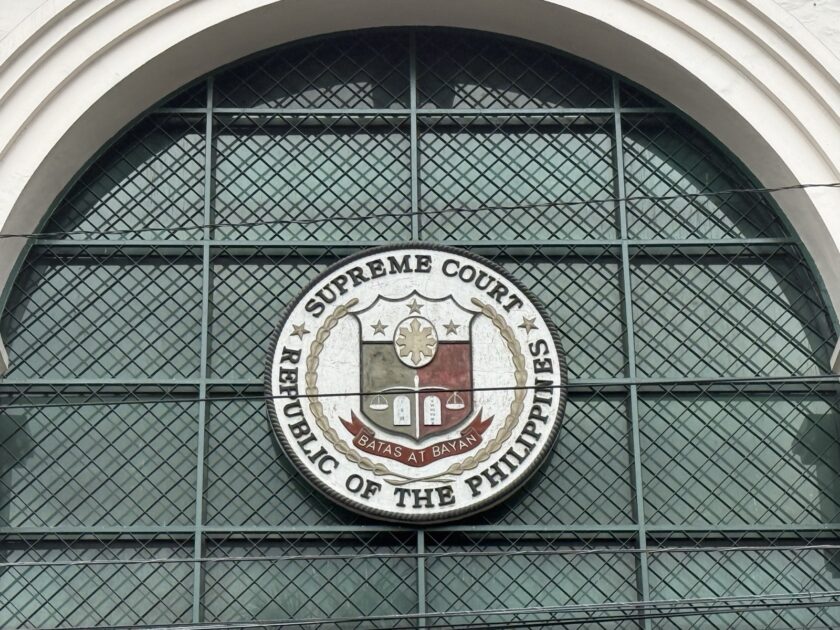
The court order was issued on October 28 by Regional Trial Court Branch 30 Judge Paul Attolba Jr. following a complaint filed by NLMRC and Bugkalot Federation of Nueva Vizcaya against members of the anti-mining community for blocking their mining equipment. The company holds a mining exploration permit covering 4,456 hectares, including ancestral lands, granted by Mines and Geoscience Bureau (MGB) in June 2025.
The anti-mining community asserted that the people’s barricade is legitimate and justified, as residents are only defending their rights, environment and livelihood.
They also questioned the validity of the mining exploration permit, saying it was granted without genuine consultation with the affected communities. Members of the community themselves have experienced the effects of the mining exploration on their community, saying it is affecting their crops and access to clean water.
The Center for Environmental Concerns (CEC) said the TRO reflects how the state treats the environmental defenders and the communities that will be affected by mining exploration activities.
“Rather than criminalizing defenders and putting their lives at risk, the judiciary and local government units must fulfill their mandate to serve the public good, uphold human rights, and environmental protection,“ the CEC said in a statement.
Meanwhile, the Climate Change Network for Community-based Initiatives (CCNCI) accused Attolba Jr. of serving the interest of the mining company instead of the community and the environment.
The group said that the same RTC also issued writ of preliminary injunction against the people’s barricade in Dupax Del Norte against Woggle Corporation’s mining exploration that led to the violent dispersal of the said barricade and unjustly arrested seven residents on January 23 this year.
“The dispersal is a blatant example of the NLMRC’s corporate greed and to the lengths they are willing to go for their own interests – weaponizing legal mechanisms, state-mandated violence, and the destruction of the environment for the sake of their profits that does not benefit local communities,” CCNCI said in their statement.
Since May, the affected community has maintained the barricade, effectively halting NLMRC’s mining exploration activities and causing the company to incur an estimated P8 million ($125, 201) losses.
Alyansa ng Novo Vizcayano para sa Kalikasan (ANVIK) argued that the court should hold NLMRC accountable rather than target the people’s barricade, which residents put up in response to the company’s activities.
“In a desperate attempt to push through their destructive large-scale mining that the community is vehemently rejecting, they colluded with the police to get the NLMRC’s mining equipment inside,” ANVIK said in their statement.
“Aside from NLMRC, their accomplice should be held accountable for allowing the destructive mining to enter our community without proper consultation such as the police, local officials, and to DENR and MGB under the Marcos Jr administration,” ANVIK added.
Kalikasan People’s Network for the Environment (KPNE) called for an independent investigation, as the community seeks for transparency over irregularities on NLMRC’s alleged bogus consultation.
KPNE also questioned whether the agencies involved in harassment and intimidation of the people’s barricade truly serve the people. “Residents have already endured arrests and criminal charges connected to their participation in the barricade,” the group added.
Legal pushback
On October 19, ANVIK along with other local environment defenders filed a position paper before the Department of Defense (DND), Department of Energy and Natural Resources (DENR), and MGB to grant their demands.
In the document, they reiterated that both NLMRC and Woggle Corporation bypassed genuine consultation along with the local community. They added that the mining exploration causes irreversible damage to the environment as Nueva Vizcaya is the critical watershed for Cagayan Valley Region.
The document also said that continued operations of both companies have been linked to serious human rights violations as police forces commit violent arrests and even use the laws against the community who are exercising their rights to protect the environment.
Over 31 cases against Indigenous leaders, a priest, and community lawyers have been subjected to Strategic Lawsuit Against Public Participation (SLAPP) filed by NLMRC since the people’s barricade started.
They demanded immediate cancellation of mining exploration of both mining companies, investigation of the alleged bypassing of consultation, and to strengthen Free, Prior, and Informed Consent (FPIC) and implementation of laws protecting the environment.
CCNCI also linked the reported violent dispersal attempt to the Ferdinand Marcos Jr. administration’s efforts to fast track mining activities in the Philippines.
The group cited the Mining Fiscal Regime (RA No. 12253) and the implementation of the Critical Minerals Act Executive Order (EO) 122 establishing a framework to develop critical minerals through domestic processing.
KPNE pointed out that this case, along with other cases of people’s resistance against large-scale mining in different parts of Nueva Vizcaya, exposes what it described as the Marcos Jr’s misleading claims of “reliable and responsible mining production.”
Local communities at Kasibu along with environmental groups demanded the NLMRC’s cancellation of mining exploration permit and to hold officials involved in letting a large-scale mining operation without genuine consultation be held accountable. (AMU, RVO)
 Save as PDF







0 Comments