
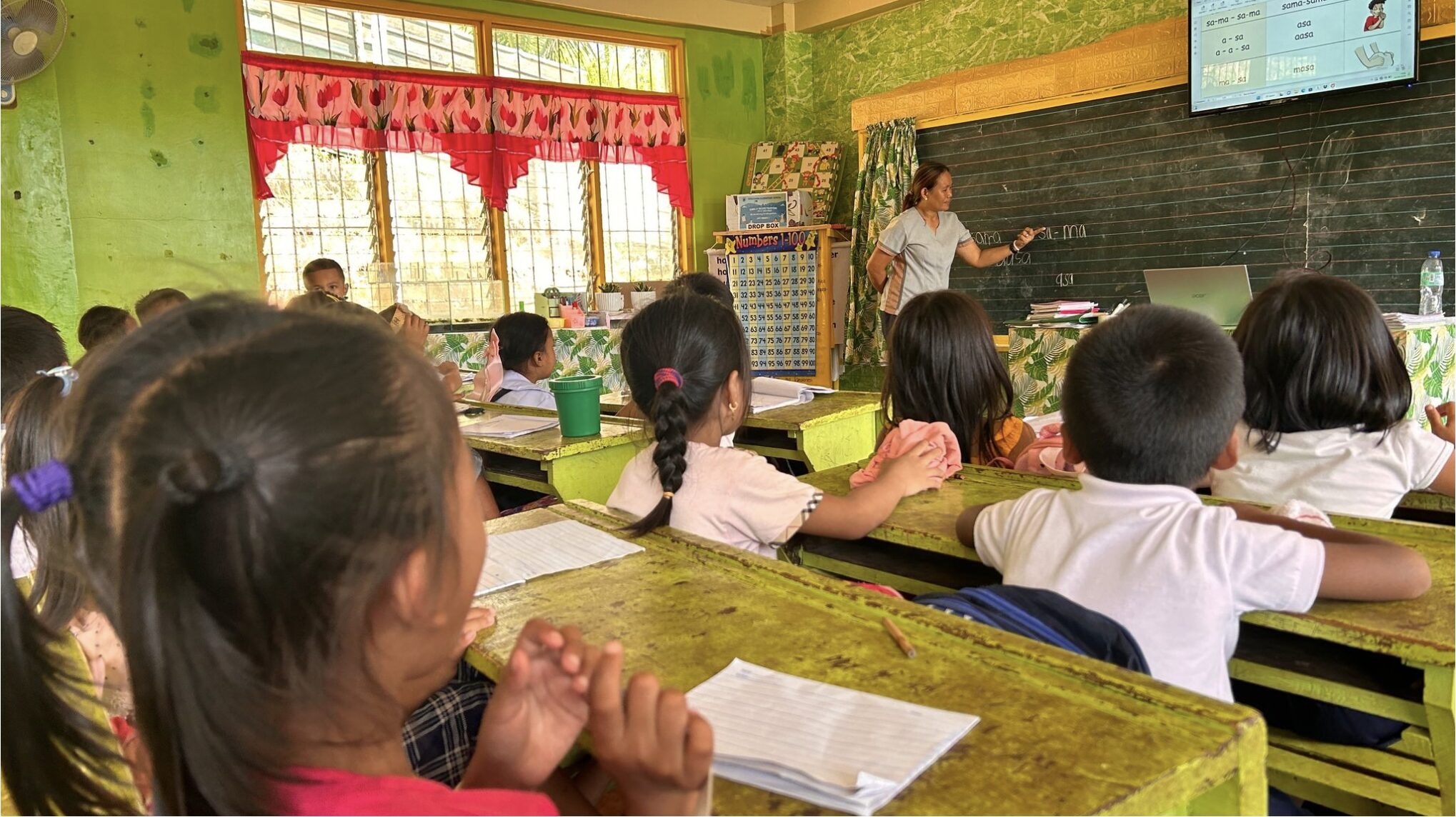
“A teacher should only be teaching and giving out grades to their students. But no, they do everything.”
By Elisha Beatrice Umali
MANILA — “The opening of School Year 2026-2027 has laid bare the widening gap between [the] promised reforms and the harsh realities confronting teachers and learners on the ground.”
The Alliance of Concerned Teachers (ACT) issued this statement as classes entered its second week. They said that teachers already feel the exhaustion due to the implementation of the Department of Education’s (DepEd) “rushed reforms.”
“Just one week into the new system, teachers are already exhausted from trying to adapt. We have yet to feel the DepEd’s promises of stronger support for school preparedness, reduced teacher workload, and meaningful reforms,” said ACT Chairperson Ruby Bernardo in a statement.
She stressed that teachers are “being shaken by the rushed implementation, overwhelmed by the severe lack of funding and support, and left struggling to navigate reforms that were imposed without thorough consultation among teachers or adequate preparation.”
ACT criticized the Deped’s lapses in supporting teachers and students despite the P1.02 trillion (approximately $16.74 billion) budget allocation for education in 2026, the highest budget ever allocated to the department.
The organization said that the budget remains “grossly insufficient” to solve shortages in classrooms, teachers and non-teaching staff, as well as millions of missing books and learning resources.
Salinlahi also questioned the state of school infrastructure after a 7.8 magnitude earthquake hit Mindanao, coinciding with the first day of the academic year.
As of June 12, the DepEd documented 1,807 classrooms “totally damaged” by the earthquake across six regions in Mindanao. Region XII (SOCCSKSARGEN) was gravely affected with 7,416 classrooms incurring varying levels of damage.
In a statement, ACT called on the Deped to expand infrastructure audit and identify school buildings constructed below safety standards. “When a single earthquake can render more than 1,400 classrooms and facilities unsafe, it becomes painfully clear that many schools are one disaster away from catastrophe,” Bernardo said.
“It is evident now that aside from [classroom] shortage, our schools severely lack disaster preparedness which is ironic since schools also serve as evacuation centers for most barangays,” said Salinlahi youth spokesperson Trixie Manalo in a mix of English and Filipino.
Persistent backlog
The Second Congressional Commission on Education (Edcom II) said that the classroom backlog stands at 165,443. Region IV-A (Calabarzon) accounted for the highest backlog share, followed by the National Capital Region (NCR) and the Bangsamoro Autonomous Region in Muslim Mindanao (Barmm).
Among the reasons for the backlog is Deped’s reliance on the Department of Public Works and Highways (DPWH) in school infrastructure construction. “Around 62% of Deped infrastructure funds are transferred to DPWH for school building construction, but completion rates have fallen in the last five years,” said a 2025 study cited in Edcom II’s report.
DPWH’s construction delays, ghost classrooms and incomplete rooms due to lack of permits are other reasons for an accumulated shortage of rooms, as stated in the report.
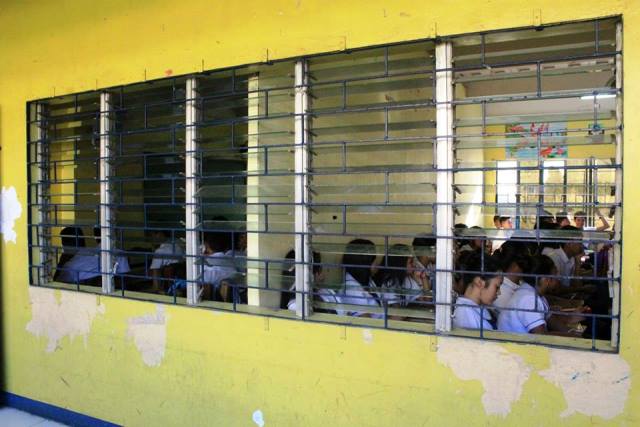
Manong (not his real name), 35, a Muntinlupa City public school teacher for eight years, said that classroom shortage affects teachers and learners. “There is a massive lack of classrooms, which makes our classroom congested. Learning is not conducive. The learners could not absorb the lessons, even with a skilled teacher, if classrooms are congested,” he told Bulatlat in a mix of English and Filipino.
He said that poor ventilation aside from overcrowding makes rooms hot and uncomfortable. Classroom congestion also creates a noisy school environment which is a distraction for students and teachers.
Edcom II’s findings pointed to classroom congestion as one of the problems in the basic education sector. Local and international studies also correlated classroom congestion to lower proficiency levels in key subject areas.
“Some schools accommodate 75 to more than 250 learners per classroom and 2,233 public schools are compelled to operate double or even triple shifts to cope with excess demand,” the Edcom II final report stated.
ARAL program, teacher workload
Another main concern is heavy teacher workload. “Many teachers teach seven to eight subjects, including the ARAL program, for six hours a day. This is a heavy workload for them,” said ACT Teachers’ Partylist Rep. Antonio Tinio in a mix of English and Tagalog in a video interview.
Republic Act No. 12028 (Academic Recovery and Accessible Learning [ARAL] Program Act) seeks to help learners with low proficiencies in reading, mathematics and science to meet DepEd’s competency levels. However, public school teachers with existing teaching loads are also expected to be ARAL tutors.
In an earlier statement, ACT raised concerns about the delegation of teachers as ARAL tutors. “Teachers with seven teaching loads are sometimes excluded from ARAL assignments, while those with six loads are automatically assigned ARAL duties on the assumption that they are ‘underloaded’ based on the 360-minute daily teaching standard.”
Bernardo said that teachers, regardless of teaching load, are overworked. “The system treats workload mathematically, not humanely, ignoring actual classroom realities and exhaustion levels.”
Deped earlier promised a P8.93 billion (approximately $147.85 million) budget allocation to the ARAL program, along with hiring 440,000 ARAL tutors. But ACT stressed that this has yet to be felt by public schools nationwide.
“The billions allotted for academic recovery and education reforms remain invisible to teachers and learners who continue to face overcrowded classrooms, shortages of textbooks and learning materials, lack of teachers and support personnel, and overwhelming workloads,” the organization said.
Aside from their teaching load, teachers are expected to carry-on administrative tasks which are not included in a teacher’s job description.
“It is the teachers that enrol learners in the Learners’ Information System. Teachers are the ones who work on their advisees’ forms. Not doing so will only show that you have lapses as a teacher,” Manong said.
These administrative tasks run throughout the school year, along with their teaching responsibilities.
At the school where Manong works, there is only one registrar to fix student records. Due to this, teachers help with administrative work. “A teacher should only be teaching and giving out grades to their students. But no, they do everything.”
Three-term school calendar
For the first time, Deped implemented the three-term school calendar in basic education. Deped Order No. 009, Series of 2026 stated the shift “shall be applied to all public, private schools, and community learning centers”.
The three terms are divided into the Opening block, Instructional block and the End-of-Term block.
Opening block will only be implemented during term one for the beginning of the school year assessments while the instructional and end-of term blocks are implemented all year-round.
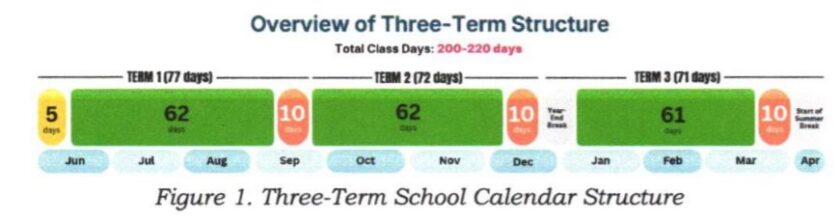
ACT saw the five-day opening block as “insufficient to complete reading assessments, determine students’ nutritional status, and address other preparatory requirements.” The alliance also criticized DepEd for assigning these tasks to teachers, despite promising a lesser administrative load for them.
Edcom II found out that legislated activities, school celebrations, and programs actually lessen instructional time for students. Public schools operate with an average of 191 actual school days per year because of these activities.
Revision of the school calendar aims for “deeper learner engagement and mastery of competencies through longer instructional blocks” since the four-quarter school calendar yielded less actual instructional time due to frequent class disruptions.
However, there have been no pilot implementations regarding the school calendar shift.
Bernardo said that the implementation of the three-term school calendar was done hastily, while teachers are not consulted and prepared for the shift.
Also, Manong shared that the preparation of teachers to accommodate the shift from the four-quarter school year to a three-term school year is “not enough.”
“The teachers lacked training. What they’ll do is just read the Deped orders and follow the instructions there. So, there’s a lack of preparation. It is simply not enough,” Manong said in a mix of English and Filipino.
Even if the three-term school calendar aims to decongest teacher workloads, additional programs, like the Aral program, have “effectively [offset] any intended relief,” ACT said.
Manong said that considering the demand of work imposed on teachers, they are not well-compensated with their salaries. He stressed the need to increase teachers’ wages since doing otherwise would compromise the students’ learning. Similarly, ACT pushed for a P50,000 (approximately $829) entry-level monthly salary for public school teachers.
The alliance called on the education department to address long-standing problems in learning resource shortages, lack of teaching and non-teaching personnel. ACT also urged the effective implementation of the ARAL program and proper support on transition toward the three-term school calendar.
Despite these challenges in the education sector, Manong chose to stay for the learners. He also hopes to spark change in the system in the little things he does. “There is a contentment in terms of my career as a public school teacher when a child breaks free from the idea that they could not finish their education.”
Manong called on the education department to examine the lived realities of its constituents. “They [Deped] should really check on the grassroots where the deterioration of the education system starts. Once you take care of your people, changes in the national education sector will be evident.”
Bernardo stressed that “no amount of repackaging reforms can compensate for the absence of adequate education funding, sufficient teachers, support personnel, classrooms, learning resources, and genuine consultation with education stakeholders.”
“We see no clear roadmap for confronting the education crisis, nor any genuine commitment to improving our economic and working conditions. But if this administration continues its neglect, we will continue to expose the true state of the nation’s schools, hold those responsible for this crisis accountable, and mobilize until the education system is transformed to serve the Filipino people,” Bernardo said. (AMU, DAA)
Author’s note: The source’s real name was withheld for safety and security.
 Save as PDF



0 Comments