DIMASALANG, Masbate –
The sun was up that day and 58-year old Orlando Capillan was all smiles.
He had gone to the shore as early as two in the morning to buy dilis
(Philippine anchovy), a two-inch long and half a centimeter thin fish
abundant along the coast of this town, some 604 kms. kilometers away from
Manila.
The island-province of Masbate may be
reached in an hour from the Pilar Pier in Sorsogon province via commuter
boat or more than four hours by the local ferryboat. Government statistics
show that it has a population of
707,668 as of May 1, 2000, sixty percent
of whom are fisherfolk who live by the sea.
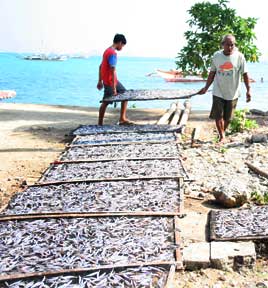
Dilis
are dried in kapils under the sun as residents
of a Masbate village look on
PHOTO BY DABET CASTAÑEDA |
Dilis, fisherfolk here said, is
the most popular catch not only because of its abundance but because it is
useful whether it is preserved wet or dry.
Dried dilis
Capillan makes a
living by selling dried dilis. He buys fresh dilis from
fisherfolk by the shore. The fresh catch is sold at P1,500 per container
($29.26 at an exchange rate of $1=P51.25). A container holds 15 to 17
kilos.
Capillan, who lives
in Barangay (village) Poblacion, then puts the dilis on a kapil,
a large drying dish made of bamboo and fishnet. The dilis is then
made to dry in the sun for a day and a half. “Hindi na kailangang
timplahan ng asin kasi lamang dagat naman kaya maalat na,” (There is
no need to add salt since it comes from the sea and therefore salty
already.) he said.
|
The secret to good
quality dilis is sun-drying freshly-caught fish. “Kaya dapat
madaling araw bibili ng dilis. Mayroon din tinitinda sa hapon pero
mabibilasa na yun kasi hindi na maibibilad,” (That is why one needs to
buy fish at dawn. Although dilis is being sold in the market in
the afternoon, it cannot be dried anymore and would only rot.) he said.
He sells his product
for P80 to P90 ($1.56-$1.75) a kilo in the town market. The bigger market
for dried dilis, however, is the neighboring island-province of
Cebu. Dried dilis are sold to small traders who in turn sell it to
market vendors in Cebu.
Fish bagoong
In Barangay Poblacion,
a neighboring village, 54-year-old Helen del Prado had just mixed salt
into several containers of dilis. She said that in 24 hours, the
dilis will be cooked in salt. This becomes what villagers call
bagoong isda (fish paste).
For 20 years now, del
Prado sells fish bagoong for a living.
Two containers that
hold 15 to 17 kilos of dilis are mixed with one sack of salt. One
container of dilis costs P800 to P900 ($15.60-$17.56) while one
sack of salt costs P155 ($3.02). Del Prado sells fish bagoong by
the can for P400 ($7.80). Like the dried dilis, fish bagoong
is in demand in the markets of Cebu, del Prado said.
Source of living
Capillan and del
Prado said that the diminutive dilis gives them a good source of
living. In fact, they said that their earnings from dried dilis and
fish bagoong have sent their children to school.
“Nakapagpatapos
kami ng mga anak sa katas ng dilis,” (Their children were able to
complete their schooling through their earnings from anchovies.) they both
said. Bulatlat
BACK TO
TOP ■
PRINTER-FRIENDLY VERSION ■
COMMENT
© 2006 Bulatlat
■
Alipato Media Center
Permission is granted to reprint or redistribute this article, provided
its author/s and Bulatlat are properly credited and notified.